
Women Warriors at Work: What Are You Willing To Stand For?
Dr Sam Collins explores the modern woman warrior at work: how to turn frustration into purpose, purpose into action and action into meaningful change while protecting your integrity, freedom and humanity.
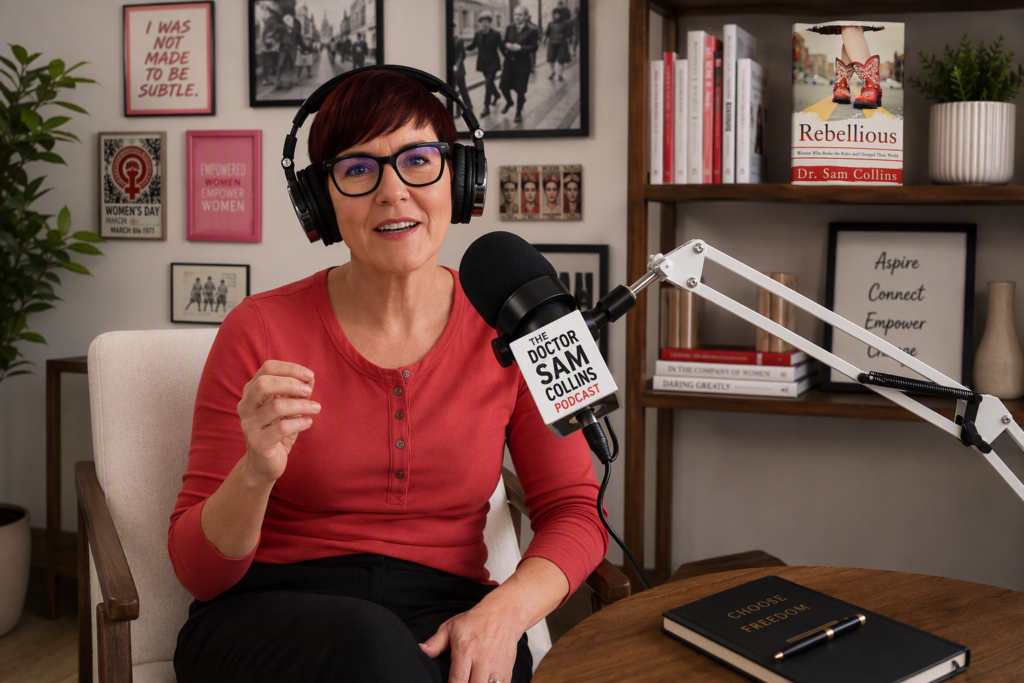
What if the frustration you feel sometimes is not a problem to solve, but a signal pointing towards something that really matters?
In this episode, Dr Sam Collins explores the idea of the modern woman warrior. Not a woman looking for conflict but a woman who has decided what values she stands for and is willing to fight for them. Whether you work in a corporation, run your own business, teach in a school, work in healthcare, lead a charity or serve your community in another way, this episode invites you to look again. What have you accepted as normal? What needs challenging? What future are you helping to create?
Drawing on the wisdom of Ruth Bader Ginsburg and the experiences of women leaders across generations, this conversation explores how to channel frustration into purpose, purpose into action and action into meaningful change. This is not about fighting everyone. It is about fighting for something.
In this episode, you will discover:
- Why frustration can be a powerful source of information rather than something to suppress
- How to identify what is truly worth standing for
- How to challenge what needs changing without becoming consumed by conflict
- Why leadership often begins with a question, not a title
- How to bring other women and allies with you rather than trying to change things alone
- Why purpose can be a source of energy when you feel exhausted
- How to keep your integrity, freedom and humanity while creating change
If you have ever looked around and thought, there must be a better way to work, this episode is for you.
Listen & watch
Transcript
Transcript
Select a chapter to read along. Use “Play this clip” to jump to that moment.
Hello and welcome to the Dr Sam Collins podcast. Today I want to talk about something that I think that the modern workplace doesn't perhaps always know what to do with. Are you ready? I want to evoke the warrior spirit in you today. So stay with me. I know the word warrior, I'm saying warrior, not worrier. Okay. The warrior. It can sound aggressive, right? It can evoke battlefields and enemies and weapons and defeat in the traditional story because one person wins and one person loses and the aim is a sort of conquest and the measure is domination.
But that's not what I'm talking about today, all right? I'm thinking about the woman who fights for other people. So she fights for the people in her team because they've just been asked to do too much. The woman who stands up for a colleague, a pupil, a patient, a client, a customer, or a community whose voice is not being heard or worse is being ignored. The woman who protects the purpose of a business, a charity, a school, a hospital. a public organisation, even a government, when pressure threatens to hollow it out.
The woman who challenges discrimination, refuses an unethical decision, defends the woman who is not in the room and will not accept that an unjust situation is simply the way it should be and the way things are and we should just put up with it. She's not looking for an enemy. She's looking for what is worth fighting for. And really important, she may not feel particularly brave. She actually might worry about what other people think about her.
She may have absolutely no guarantees that she's going to succeed and she may have failed many times along the way. But being a warrior doesn't mean that fear disappears. It means that something matters enough for you to act anyway. So perhaps the opposite of warrior is not peace. Perhaps the opposite is actually indifference. You're probably busy. Are you busy? Most people are very busy these days. We move from one thing to the next, one meeting to the next, one deadline to the next, one problem to the next, one email to the next, one target to the next.
We're supporting each other. We're managing, trying to figure out what's going on with the politics. We're trying to keep everything above water and everything moving, and you can become extremely competent at just getting through the day. I mean, that's enough, isn't it? At the end of the day, you're like, woof, and then try and get some sleep, wake up the next day and do it all again. But I do think there's a danger in becoming so occupied with what's right in front of us and with getting through our work day that we stop looking perhaps as clear as we should at the work itself.
And we sort of stop asking whether decisions being made are right and are ethical and are for the good of people. We stop noticing when someone's voice is missing. How could we? We're tired and we're busy and we're trying to get through everything else. You can become accustomed to processes that just waste people's times in cultures that drain talent and systems that reward the absolute wrong behaviour. You might see something that troubles you or feel a sort of a flash of anger or frustration, but then move quickly to the next thing.
This is how you can end up floating through work and floating through life and not in a good floating way necessarily. And it's not because you don't care. And it's not because
You don't want to do anything about it. It's because the pace of work and life these days leaves you so little space to turn caring into real action. So if this sounds a bit like you or someone you know, you're in good company. We're all there. And we're going to talk about how to be more of a warrior at work. A warrior at work, what does she do? Well, she's got her eyes wide open, right?
Wide open. She's noticing, she's asking questions and she refuses to let busyness become a reason for indifference. She thinks about what she can raise, what she wants to stand for, what she can influence and who might do that with her. Now, you might be listening to this and thinking, I'm not angry. I like my job. I enjoy what I do. I have a good manager. I have interesting work. I have opportunities ahead of me.
Why should I be looking for a fight? And I'm not asking you to look for a fight and I'm not asking you to manufacture some kind of dissatisfaction or become suspicious of everything that's already working well. Your happiness and your success matters. Enjoy it. Enjoy yourself. But comfort is not the same as complete awareness and a good personal experience for you does not tell you what everyone else is experiencing. And in fact, if you are in a space where you like what you do and you don't care what other people think so much and you're happy in your work, then there's actually a great space to become more of a warrior too, all right?
So each stage is important. Other women or other people might not be able to see all the parts of the organisation and… We can't always see that. There's always parts of things that we can't see within the bigger system. And different people or different races, abilities, ages, classes, caring responsibilities, locations, contracts or level of seniority, if you work in a larger organisation, may expose them to obstacles that have never appeared on your path.
And so when you become more aware of not only what is happening with you, but what is happening with others, it may fire up something inside you. It's not necessarily about being a warrior only for yourself, but being a warrior for others. All right. And that will be one of the most fulfilling things that you could ever do with your life. I promise you that. All right. So just because work is working for you. and that gives you a level perhaps of influence or status or security, it does not give you proof that it's working for everyone.
So look again. What do you not know yet? Whose working life have you never asked about and where do you need to increase your awareness or education? What have you accepted as normal simply because it's not ever affected you? Now, this isn't perhaps a particularly work example for you, but it's a work example for me, where my work with regard to empowering women and women as leaders and looking at all the different issues that can adversely impact women and girls.
I remember having a conversation once with a fantastic man, actually, who was running, I think, continues to run. a charity in the UK that focuses on modern slavery. And this is something that massively impacts women and girls globally. But in my mind, it was in some country far, far away where women were being trafficked to work. And that is true, too. I didn't know, though. And I felt a little bit stupid at the time.
But, you know, you don't know what you don't know. I didn't know that modern slavery existed in London, where I'm from, and in Los Angeles, where I live. And he was like, this could be happening next door to you. And I was like, I just, what, what? And you know, like girls, young girls could be taken from their garden in your, you know, potentially white affluent neighbourhood if you live in one of those.
So this was just, this absolutely blew my mind. And, you know, his charity is based in Bristol in the UK. And this is a place because Bristol apparently is somewhere where they can ship women and girls in without as much, what would we call it, checks? I don't know, that might happen in other parts of the UK. Anyways, a few years ago may have changed now, but I remember thinking this and thinking, wow, once you know these things, you don't know them.
And it's not something that directly impacts me, but it's something that in my work that I could raise awareness of, I could do something about. So start looking around, open your eyes and see what's happening perhaps in where you work, in your neighborhood, in your, you know, sort of wider world of community or in your country that maybe you thought was someone else's problem. It might be a little bit closer to home than you actually think.
Now I know a lot of you work in businesses, you know, you work in small, medium sized, large businesses. And have you ever really looked at who's running this organization? How many women are making the consequential decisions? Maybe they say something like, we're really proud because we've got like 20, 25% or even 30% women. And that's a really amazing thing. And it is an amazing thing if we were looking a hundred years back, but hopefully in a hundred years time, it wouldn't be an amazing thing at all.
But do the women, if there even are women, do these women represent different backgrounds, different races, different lives? And really important, especially if you're a younger woman, are these women that you genuinely genuinely aspire to become. Do you look at her and go, oh my God, I really want to become her? Or do you look at her and go, oh dear God, I don't think so. She looks exhausted. Perhaps they have had to surrender too much of themselves to succeed and they're a version of their male counterparts.
And that might not be that attractive to you when you're thinking about whether to be a leader in an organisation. If you work in a charity or a school or a hospital, or a community organization or a shop or an office. Ask the same questions at the scale that fits your world. Who owns it? Who governs it? Who sets the direction? Who controls the money? Who shapes the culture? And who decides whose needs are important?
If you run your own business, look really honestly at the organization you are creating. Whose voices influence you? Who benefits from your decisions? and what values become visible in the way that you work. And this is something we always work on. And it might take a bit of extra effort. I remember a couple of years ago in London when we created the Aspire House. If any of you ever came to the Aspire House in the East End of London, it was a four-story building that was a place for women to commune and learn and grow.
Oh my God, I love that place. Inspired by feminist history. And I remember we said, we made a pact, our small team, and we said, we're only going to use women-owned businesses as suppliers. So everything, you know, coffee, wine. Yeah, we had a bar, it was fabulous. Food, napkins, just anything, we would find women-owned businesses. And soap. Stuff in the toilet, everything. And it, you know, it wasn't always easy at all to find those women owned businesses.
And sometimes it took a bit longer and sometimes it was a bit of a pain in the, you know, what to do that. It was so fantastic. And really, I suppose, a big part of our brand and living our values. Cause it's one thing to say our values are this, but it's a totally different thing. Isn't it? To actually live those values. especially if it takes a bit more work. All right.
And so really encourage you to look at things in your business, if you have one, and just make sure that you are looking wide and open into how it could be even better. Look around the places that you work. And if you have to stand for something and fight for something that is important to you,
it is going to not only show you as a person of character who is standing up for your values, a warrior, if you like, who is ready to fight for what she believes in and of course do that in a way that other people come with you. All right. So this is, this is very, a very important question I think today, and we don't have to wait until injustice reaches us personally before we decide it matters.
In fact, anger, and some of you will know from listening to my podcast before, perhaps that I'm quite a fan of the emotion anger because I see it as a catalyst and I see it as not Not anger that hurts people or anger that is aggressive and has power over people. I'm talking about anger as a catalyst for change. Just like my last podcast last week, where I was talking about love as a force for change, I'll talk about anger that is really an energy looking for direction.
So you might carry some, you might call it frustration or irritation about unfairness or waste or hypocrisy or poor leadership. It's not much great leadership in workplaces right now, is there? It's such a shame. There's quite a lot of good managers, but there's very few great leaders, don't you find? What do I mean by that? People who are inspiring us to go with them somewhere. People who breathe life into us. People who are willing to to stand for something and stand for their people rather than just themselves.
Love to see better leaders. There's lots of exhausted teams and brilliant people really being overlooked because they don't quite fit in or they don't fit in at all with this sort of norm of how you should and shouldn't do things. So you might be a bit frustrated that perhaps your company makes these very eloquent commitments. and then fails to change the actual decisions, the budgets, the measures and the behaviours that would make those commitments real.
And I know there's lots of organisations out there that are really trying on this. And this is where you as a warrior can come in, I think, you know, like getting on the train of those companies that are really understanding now that they need to be more purpose driven, not just for a commercial gain.
and not just because it looks good and not because it makes a good social media campaign but because it's important. It's important and it's a way that they will sustain their legacy for tens or even hundreds of years to come. Now perhaps you've been advised or you've received some feedback that you need to calm down or be less aggressive or stay positive. or the ultimate one I really dislike right now is be more resilient.
Do not take it personally. Do not become the difficult woman in the room. You heard anything like that? You heard anything like that? I mean, it's a wonder sometimes if people realise this kind of feedback that is given is very destructive. I get women coming to me in my workshops and conferences and events over many, many years now. And they'll say to me, I received this feedback and I say, what was the feedback?
And they'll say, I was told I was too emotional. I was told I was too passionate. I was told I need to turn it down. I was told I need to be louder because I'm quiet or whatever it was. And I say, when did you get this feedback? And they'll say, 10 years ago, five years ago, 15 years ago, one year ago, not like last week. They've been holding onto it for years, years, trying to figure out what to do with it.
Okay. They have a very quiet persona, yet they're told to be more loud. Well, if you're naturally quiet, how the hell are you going to be more loud? That's an impossible task. Isn't it actually the job of the company and the team and the managers to be more inclusive of people who are quiet? Why is it on that person to become more loud? All right, you might learn a couple of techniques to speak up at the start of a meeting or to butt in when you can't get a word in edgeways or whatever it is.
There's lots of techniques out there. But asking someone to fundamentally change who they are is absolutely stupid in my opinion. See, that's me there, getting angry at stuff that I want to change. So it's actually a force to do something with it rather than just saying, moaning, complaining. whining about it, which you know, we can all do. It really is a opportunity when you are a warrior to say, okay, this is happening.
This is what we can do about it. Come with me. All right. Come with me on this journey. So let's say a woman warrior turns frustration into focus, focus into action.
an action into change. You're fighting for something, not merely against something. And I do think that there is a big difference there. The old warrior story was dominated by fighting against, power over. As a modern woman warrior, we must be able to say what it is that you're fighting for and with and for who. You may oppose a decision, a behavioural system, but opposition does not have to become your whole identity.
Alright, and I think this is one of the reasons why many women may shy away from the word feminist, may attach it to a stereotype of an aggressive campaigner. You can keep your eyes on a horizon beyond the immediate conflict. You can help people see the future that the fight is intended to make possible, and I think that is the key here. Helping people to see your vision, to see what it is that perhaps they don't see yet.
Now that might make you kind of irritated that they're not seeing it, but they're not mind readers, so it's up to us to find ways to communicate what we are for and not merely what we're against. So this can be, you might think that there's problems with a toxic culture, for example, but actually the more that you talk about a toxic culture, the more it might alienate people. Perhaps if you talked about a peaceful culture, a culture of authenticity, a culture of influence in buying, a culture where people can be themselves, you may have more people that start to get it and want to follow you.
All right. This isn't soft and it's certainly not weak. And it is not, please, a carefully worded business case designed to fit the corporate template and secure your budget. It's a much stronger case for change. It's about your people, your customers, judgments, reputation, innovation, results. In a school, it's about the kids. It's about the parents and the guardians and the carers. It's about learning and it's about belonging. In the hospitals, it's about the patients, isn't it?
It's about them. It's about their safety and their dignity and their quality of care and the people that care for them. In a charity, it's about the mission. the people and the communities that your charity exists to serve. And in your own business, it's about the kind of livelihood and impact that you want to build yourself. Whatever you're setting, you're deciding the show, right? You're on the stage and the aim is not to argue to win an argument.
The aim is to change the future. Let me talk a bit about RBG. RBG? Ruth Bader Ginsburg. The US Supreme Court Justice, RBG, who did pass recently. But she, we, in the Aspire House, I remember we had this huge poster of her downstairs. We had like a basement bar. It was really cool. We used to do our food and drinks in there. And before you walked into the room, there was this big, massive poster of RBG.
And the caption was this, fight for the things you care about, but do it in a way that will lead others to join you. Well, I love that, don't you? So she was all about injustice, particularly for women's equality. And she was often disagreed with, she would always dissent on things and just absolutely fabulous though about really making sure that what she did was done in a way that was really integral to her beliefs and values, but also brought people with her as much as she could rather than alienating them.
So these words from RBG, they do not tell us to make your ambitions smaller. They certainly don't ask you to keep everybody, you know, really comfortable or say the right thing or make injustice very palatable. They preserve the word fight, but they add the test of leadership, doesn't she? Are you acting in a way that enables other people, some who are going to totally get you and others who are going to totally not, to see, care and join you?
That's the difference between private frustration and public leadership. Resistance says, this is wrong. Leadership says, this is wrong and this is what could be better. Here's how we can begin. Will you come with me? You know, it's got this inspirational aspect to it where we really encourage people to come along. Zipper water there. So as a warrior leader, You don't merely discharge emotion into a room and leave everybody else to deal with it.
You think strategically. Who is affected? Who already cares? Who has the evidence? Who has the influence? Who sees different parts of the system? Who would make this change meaningful? Who would help me with the people who do not yet agree? So you need followers. But not… I'm not talking about social media follows in that sense. I'm not talking about follows in that outdated sense of people have to follow you and have to obey you because you're in charge.
This is about creating participation and momentum and gathering people around you. Even if you're the youngest person in the room, the most junior person in the room, the oldest person in the room or whatever it is. Warriors once carried banners because a banner made the purpose visible. It told other people where to gather. The modern equivalent may be a compelling question you ask, a clear proposal that you present, a shared piece of evidence that other people have not seen, a pilot project that you're brave enough to try, or a vision of a better future that people can help create with you.
Now, one of the things that I get asked a lot, what if they call me difficult? What if they call me difficult? What if I'm called difficult? What if I'm called that angry, rebellious, feminist woman? This is maybe where you might hesitate on this. You might think that you'll be seen as unprofessional, career limiting, perhaps if you do something like this. Maybe people won't like you. Maybe you're going to rock the boat.
Maybe this is not worth it, right? Just keep everything going as it should. Now, these fears, they are not imaginary. You might be judged differently for speaking out about something. And we do know, of course, that power is not evenly distributed, but silence can also carry a career risk too, I think. And what I have noticed in the past few years, particularly is that when we do speak up about things that are important to us, and if we do it in a visionary leadership way, and we are very clear and concise to back ourselves up on our points and we're calling other people to action, we do it with respect and dignity, but also fierceness.
It can actually be incredibly career enhancing. I think there's a lot of people just keeping their head down and I don't want to knock that because there's… are lots of reasons to do that. But, you know, if we spend years just sort of doing everyone else's priorities and smoothing over disagreements and avoiding difficult questions, we may become known as safe and dependable, but remain unseen as a leader. If you run your own business, you can become so consumed by delivery and survival and paying the bills that you stop challenging the assumptions on which you originally built your business.
Now, being in business myself for 25 years, this is something I constantly and never-endingly test myself on. Leadership is not demonstrated only by delivering what already exists. You demonstrate it by seeing what needs to change. And isn't that the entrepreneurial spirit in itself, like seeing things, seeing gaps in the market, seeing products that haven't been created yet, innovating new ways of working and helping people move towards that. You may ask somebody, what do you want?
And perhaps they don't know yet. So your constructive challenge can be career enhancing when you connect it to purpose, evidence, relationships, and results. It can show judgment. It can show that you understand the wider organisation, not just your own task, your own department or your own role. That you even perhaps understand the wider markets. Even you even understand the wider geopolitical environment that your company works in. Imagine that. It can show that you can see risks before they become a crisis. and identify potentials and opportunities that others haven't seen yet and start to mobilise people across boundaries.
So I really think the answer is not to disguise everything in this sort of humanless, bloodless corporate language. Nor is it to charge into every room with no regard for consequence. The answer is to become powerful and skilful.
in the fight. Hmm, powerful and skilful in the fight. I'm not asking you to simply raise the temperature, raise the possibility. I'm also not asking you to be a martyr. I'm not asking you to sacrifice yourself for every cause. You've probably already given way too much and rescued way too much. Be discerning and choose what is yours to fight for. And remember that the endless small battles can consume the energy you need for the work that really matters.
I invite you to ask yourself, is this merely irritating me or does it reveal something important? Is this about my ego or is somebody actually really needing my help right now? Can I influence this? What's the scale of action? What needs to be involved? And sometimes your warrior act, not sometimes, actually a lot of times, your warrior act will be a direct no. Sometimes it will be a quiet question that exposes an assumption.
And sometimes it means collecting evidence, building a coalition, protecting someone else, not doing an unethical request, leaving a system that demands too much of your integrity. So it might not always look you know, so overt, like you might expect it to. In fact, some of the most phenomenal warrior acts I have seen of the past few months have been those that are starting to do much less and say no much more than they ever have done before.
Being effective as a warrior means choosing your timing carefully. Be careful and Be strategic, understand things, listen to your own objections without constantly abandoning what you know is really important for you to stand to and stand for. And please don't do it alone. I know this sort of lone warrior woman is perhaps an attractive image, but it's a dangerous model of change. One woman might begin something, but lasting change is rarely a solo.
a solo thing. I was reminded of this today because I was reading questionnaires for an event I'm hosting in London in about 10 days. And one woman, she was writing her questionnaire and she works for a large global organization. And she was saying in her questionnaire that she was bringing two other women with her because she wants them to meet more women. She wants them to, she wants the three of them to have some time to think and collaborate more about how they can make a difference in their everyday lives and work.
And I thought to myself, she could have easily come by herself and I think she has come by herself before, but this time she chose to bring two women with her. And I thought that was really interesting that we don't have to go it alone. and that she's probably handpicked these two women that she's decided to bring along with her. I'm curious to see them, I might keep a little extra eye on the three of them throughout the day and ask them what they're getting.
So this might sound like a small act perhaps, but it's not. These everyday actions in the decisions that we make, the things that we sign up for, the things that we do, the things that we don't do. This is where the real grassroots, raw change happens. She's become a warrior and a leader before this event has even started. She's looking beyond her own self, isn't she? I mean, I'm sure she's coming for herself too.
She's created this small circle of possibility and these three women are now going to experience this day together. compare what they notice and return to their work with enhanced relationships. Now imagine what would happen if you did that too, instead of attending another event alone, absorbing ideas alone and returning to the same environment alone. What if you deliberately brought other women with you? What if you arrive together, ready to listen, question, connect, act, eat, drink, relax, have fun, talk, discuss together.
I'm not talking about networking. Networking, I've never loved that word. Networking can sound transactional. Well, quite frankly, because it often is, and quite surface level as if the task is to merely collect contacts and advance yourselves. In fact, one of the reasons I started Aspire 25 years ago was because I attended a lot of networking events in London and found them just not for me. Warrior women need something deeper. Circles of purpose, challenge, solidarity.
You need the women who sees what you see and the women who sees what you have missed. Very important. You need the woman who has access to a room you cannot yet enter. The woman who will tell you when your approach is not working. The ally who will speak up when your position is exposed and the colleague who will help you turn an idea into a credible proposal and a proposal into a change that people can feel and want and are motivated
to work with you on. So I wonder what this would look like on an ordinary Monday. It doesn't have to come begin with a public campaign or a dramatic confrontation. Most change starts in the ordinary moments. You might notice today that the same voices dominate every meeting. And you might. do something different in the next meeting. Say, oh, we haven't heard from Senso. Give someone else the space to speak up. Just gently, easily.
Very warrior-like. You might ask if whose perspective is absent before a decision is signed off. You might challenge a target that rewards speed, but not wellbeing. You might bring some colleagues together to understand. Why is it that talented women keep leaving our company? You might question a school practice that repeatedly disadvantages the same pupils. Lots of things you can look at when you really look. You might insist that a new technology is tested with those most likely to be disadvantaged by it, you might say.
I'm not sure this is consistent with what we say we value. Or before we proceed, can we look at who benefits and who carries the cost? Look at the looks you might get on that one. Or I know we've tried this before, but the problem hasn't gone away. What would we need to do differently this time? Or simply, I care about this. Who else does? These are not theatrical acts. The leadership acts.
They open up choices. You have to stand your ground. You have to take a deep breath. Find a dose of the brave pill. Hold yourself where other people frown or say that's for another conversation or not. That's not relevant right now and still keep going. You will need plenty of fierceness. Without cruelty. Conviction without contempt and determination without dehumanising other people.
Very challenging when some of the people you most need to convince are those that are doing just that. Fighting what's right does not require you to hate those who disagree with you. I know this is a big and tricky one for many of us. It asks you to be clear and to retain your humanity in how you challenge it. It also doesn't mean you need to be endlessly pleasant. It doesn't mean making the truth so comfortable that nobody has to change.
It means refusing to confuse humiliation with impact. Stand your ground. Hold your own. Breathe. Stay calm. Put your head back. You've got this. If the way you fight for everybody retreats you into defensiveness, you've lost it. That's what you have to come back from. If it makes you so agreeable that the issue disappears, you might be preserving harmony without really creating change. Your warrior leadership lives in the tension between these two.
So fight hard for the future, not against the humanity of people you need to help build it. So an invitation for you. Keep your eyes open.
Notice what other people have normalised or have left unsaid. Turn any irritation into purpose. Your purpose into proposition and your proposition into collective action. You do not have to fight every fight. You certainly don't have to be fearless. You don't have to have the perfect language or the complete plan. You do not need to be a certain age, a certain style. a certain background or even a certain seniority to do this.
I think you do have to decide though whether you merely want to just sort of get through your work or whether there is something that you're willing to stand for within it. That's where your warrior work begins. And for those of you that are too tired, maybe you say to me,
Oh, Sam, I don't have the energy to fight anymore. I already have enough to do. I'm working, I'm caring, I'm managing, I'm delivering. And I'm trying to hold my own life together. Must I fight as well? My answer's no. Go to sleep. Spend some more time in bed if you can. Rest yourself. And know that there are many around you who will… hold you and walk with you during this very difficult time.
There's going to be times in your life when you are ready to fight and there are going to be times in your life where sleep is way more important. It's not all on you, OK? You don't have to repair an entire organisation or rescue every part of a business or solve every pressure or make yourself responsible for every injustice. That's just another form of captivity and I'm interested in your freedom. But I do think there's a particular brand of exhaustion that comes from every day seeing the same things and just sort of swallowing it and carrying on.
You know what I'm talking about? There's a fatigue in continually adapting yourself and being something that you're not. And there's tiredness in that performance and using your strength to be resilient and endure things. So take it one step at a time. Choose one thing, one conversation, one woman to stand beside, one practice you will no longer pretend to see. And perhaps your warrior spirit is telling you that it's time to rest, recover. sleep more, take that walk, eat a bit more healthy, and pour as much love and energy into yourself as you have done to others for so many years.
Acting on what matters to you can make you feel more alive than you have felt in a long time. So be free, dear one. Free enough to succeed without disappearing. Free enough to really be yourself and to keep your integrity.
Whatever happens, we've got you. A couple of things to take away from you from this session today. Number one, think about, I'm saying think about, just think about it for a start. Think about what it is that you want to stand for at work and what better future are you trying to make possible, either for yourself or those directly around you, or maybe more broadly in your organisation. or in the communities your organisation operates in, or with the customers and clients that use your company or organisation or school or hospital or whatever it is.
Number two. What is one small constructive move you can make in the next seven days? So, could be, isn't it, get a bit more sleep, could be speak out in this meeting when you don't do normally. It could be to invite a couple of people to come along with you to something you were going to on your own. It really doesn't need to be massive. But it could lead to massive change.
And thirdly, which women and male allies will you invite to stand with you to help strengthen the idea and help others join? I'm sure that there's others who think like you, feel like you, and have the same frustrations as you. And inside there's that inner warrior. So three questions to take away. So this is not a call for you to become more aggressive or to treat workers war. It's a call for you to recover your willingness to protect what matters.
It's certainly not reserved for CEOs or board directors or government leaders, although all of them are completely welcome. Okay. Belongs to all of us. So whatever you do. Whether you stay at home, you're returning to work, you're retiring, you're building something new, you work in a big business, small business, no business, whatever it is. A title might give you authority, but purpose gives you direction. Anger may give you energy, but leadership gives that energy form.
Other women and allies can give you strength, perspective, and reach. Time to begin. Thank you for listening. Until next time, evoke some of that warrior.
Related content
Podcast
48:19
The Wars We Carry: Why Peace Begins Closer To Home Than You Think
What if keeping the peace is the very thing preventing you from being free? At work, at home, in your relationships and in your own mind.…
 Podcast
48 min
The Secret Women Activists Among Us
Dr Sam Collins explores how women are quietly using influence, information, relationships, courage and collective action to challenge unfairness and create change inside the systems where…
Podcast
55 min
For The Days You Want To Quit
When the demands of work, family, caring, relationships and the wider world feel overwhelming, Dr Sam Collins explores exhaustion, hope, purpose and why your contribution matters…
