Do It Anyway: Even When It’s Not Practical
Dr Sam Collins shares how one small action can become a life-changing commitment—and why freedom begins when we choose what is ours to do.
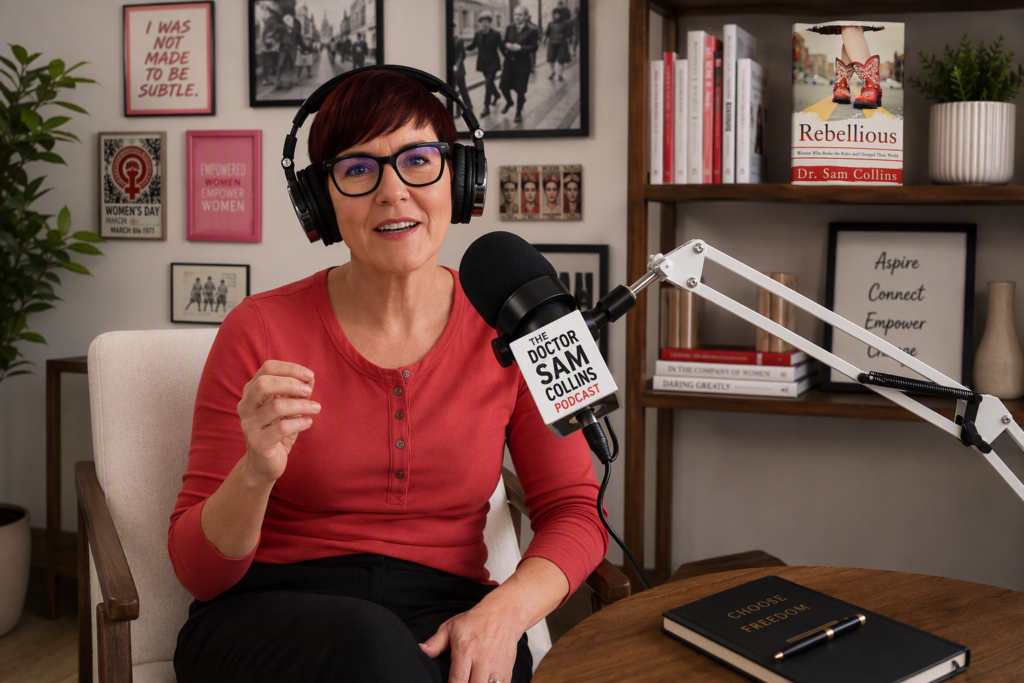
Have you ever seen something happening in the world and thought, “Someone should do something about that”, quickly followed by all the reasons why that someone could not possibly be you?
You are too busy. You do not know enough. You are already juggling too much. The problem is enormous. What difference could one person possibly make?
Dr Sam Collins shares the story of watching a television report about women in Afghanistan while heavily pregnant, running Aspire and caring for a toddler. She felt heartbroken and helpless, but started small. One tiny action led to another, then to a mentoring programme and eventually to the Aspire Foundation and a much bigger commitment to creating change for women around the world.
This episode is about freedom, agency and our ability to change the world from wherever we are. Not by doing everything, but by refusing to believe that because we cannot do everything, we should do nothing.
What you will get from listening:
- Inspiration to move from helplessness to action.
- A way to turn a huge problem into one small, practical next step.
- Permission to act before you are completely ready.
- A reminder that your contribution matters.
- A different way to think about freedom: the freedom to choose your response and use your influence for change.
You do not have to change the whole world. Start with your piece of it.
Ask yourself: What is mine to do?
Then do it anyway.
Listen & watch
Transcript
Transcript
Select a chapter to read along. Use “Play this clip” to jump to that moment.
Hello, everyone, and welcome to the Dr Sam Collins podcast. Here's a story. Now, as many of you might know, when I started Aspire in 2001, when I was 29 years old, I wanted to do something that helped and made a difference to the world for women. And as grandiose as that sounded, I sort of had in my head a bit of what I would have called at the time my master plan which I didn't actually tell anybody but I was thinking in my mind that if perhaps for the first sort of ten years of Aspire I would work on establishing reputation and getting as good as I can at my coaching and training skills and running workshops and doing one-to-one coaching and the rest of it and building the Aspire community that was sort of always in my mind. And I thought, if I could build the Aspire community up in terms of the types of people that were in this community, women who really wanted to make a difference and give back to the world, to other women, then perhaps eventually I would be able to do something that was more impactful on a global level. that could make a difference to women in a lot of different countries, because I was… I started Aspire in the UK, where I was born, but then in 2006, so five years into Aspire, I actually moved over to California for love, because I met somebody who was not from California, he was from Manchester, but… he lived in California, which was always my childhood dream to live close to the ocean. So it was a combination of he was amazing, is amazing, we're still married 20 years now, but also he lived in California, it was magic, right? And so I was working, I was doing something that a lot of people at the time were not doing, which was working virtually. with clients in the UK, but I lived in the US, and also I was travelling backwards and forwards to the UK to still deliver my workshops and most of it. And we had been spending our time starting to build a family, and I had my first son in 2008. So I was giving you a little bit of background here. So I've got… small child who was not the easiest of children and continues to be not the easiest of adults. I will say they don't really change too much from a child adult. But anyway, another story. Anyway, so I want you to picture this. It's actually 2009 and I am heavily pregnant with our second child.
and I am doing my best to balance everything. So I'm still running my own small business, and I'm still traveling back and forth, and I have a, what was he, a year and a half old toddler, and I'm very pregnant. And so there's lots and lots of good reasons to just… keep dealing with that. That's plenty for any person and I'm leading a much more privileged life. I've managed to buy a house and I have a lot of the things that I need to have. I'm able to get them and so this is good. I have lots of reasons to be happy but at the same time I'm feeling quite stressed out. I was never a good pregnant person. I would be quite envious of women who would say things like, I love being pregnant. I would just not understand that at all. And I had, I can't remember what it's called, but I had the thing where you throw up consistently through your whole pregnancy. So for a lot of people, it happens just the first three months. For me, it happened the entire time. In fact, I would joke that there was a takeout menu that we would have and I would look down the menu and I had literally thrown up most of the items on it, maybe a little bit TMI for you. But anyway, so there were just so many reasons to not add anything else to my plate. Let's just say that. And many of you who are perhaps juggling families and caring responsibilities, whether that's caring for parents or caring for siblings or caring for children, plus working, plus your own health and wellbeing, it's a lot, isn't it? It's a lot. You have to be really quite good at managing your time and the rest of it. And without… I think really noticing what creeps in is a sense of feeling quite sorry for yourself in a lot of ways. And I have so much I'm trying to do, so much I'm trying to juggle, and the rest of it. And every day is physically exhausting. I don't know if I'm resonating with any of you that are going through this right now, or you remember something like this. Anyway, so I remember
going out one day and buying a whole load of things for the birth of my second child. So we bought some things for the bedroom and we bought some other things and we bought some bits and pieces and I remember coming home and laying it all out. I remember there was this little onesie that was really cute and lovely and I spent probably a little bit too much money on it. And I remember laying it all out and they're just thinking, I'm absolutely exhausted. I'm going to go and sit down for a little bit. And my husband was like, yeah, go and sit down, watch a bit of TV. And I remember waddling because I was, well, yeah, I was probably about seven or eight months pregnant. And also I was not one of those people that like has the perfect figure and then you've just got a bump. I just was one of those people that just expanded everywhere. huge wee ball. Does anyone remember wee balls? So they were sort of these round toys that you would sort of knock them and then they would just go bounce back up again and they were, you know, sort of egg shaped. That was me. Huge. And I just couldn't stop eating. So, yeah. Anyway, so it was this huge wee ball that wobbled and wee balled into the lounge and plopped down on the settee and turned on the TV. Just put the TV on. And I had been watching, I think it was when the time of, like, some of these reality shows had really started to take off. And I was watching something like one of the Housewives shows and getting quite into it because it didn't require any brain power from me. But that didn't come on. What came on was CNN. So my husband had been watching CNN, so it was on the CNN channel. And so CNN popped on and I thought, oh, let me just quickly turn that over to something a lot more palatable. But CNN came on and it instantly caught my eye because it was a report about women in pregnant women. So I was like, okay, that sort of caught my attention because I was pregnant. And it was Christiane Amanpour reporting and love her who doesn't. And it was a report about women going to birthing centers in Afghanistan on donkeys. And I was like, oh dear God. Okay. So I started, I was hooked onto this report and I found myself just couldn't tear my eyes away because it was women. It's a sort of a live thing that was happening. Women who were in the same situation as me in terms of their pregnancy, but they were on a donkey going through mountains in freezing cold trying to get to a birthing centre so that they could give birth, and it was in very dangerous circumstances that they were travelling. And then once they would get to the birthing centres, the chances of them dying in childbirth because of the level of care that they would receive was something like one in five. And…
I was watching this, and I will tell you, and I know that this happens, and it might happen to you because I think we're starting to get so immune to all the terrible things that are happening around the world, is I was so tempted to turn it over to housewives. But for some reason, I didn't, and I kept watching this thing. And… I was watching it and maybe it was the pregnancy hormones, maybe it was the depth of reporting, maybe it was the images in front of me and the feelings that it invoked in me, but I found myself just tears flowing down my cheeks and this really strong sense that I have felt before and I continue to feel sometimes. which is a sense of helplessness. Do you know what I mean, where you're just like, why is this still happening? And what could I possibly do about it, little me? And isn't this really the responsibility of governments or global charities, perhaps, or an institution that's not me? And so I think that all of that was going through my mind. And I will tell you that there are plenty of times where this still goes through my mind and I make myself actually look at CNN website every morning because it gives me a jolt of ignition to want to do something. But I remember looking at this and thinking, okay, this is terrible. And I had my cry and I watched the report and then Absolutely, I did, as predicted, I turned over and started to watch Housewives a lot more palatable and I recovered myself. But it somehow stayed with me and I thought to myself, there's lots of reasons to do absolutely nothing about this and I'm sure that there are lots of people out there who are doing something about it. And there are so many reasons to not do anything about it now, Sam. You're pregnant, you're busy, you've got a little toddler, you're trying to still earn money for the family, you've got big swollen ankles, you weigh over 200 pounds, you're going to have a baby in a couple of months, and you're not…
a not-for-profit NGO charity person. You've never been to Afghanistan. You know nothing about it. Shut your mouth and just carry on with what you're doing. Yeah? But it wouldn't go away. I couldn't… No, it just wouldn't go away and I kept getting these sort of flashes in my mind. And so the next day I thought, Sam, just what could you do? If there was one thing you could do right now, even if it's very small… What is it? So I fought the battle in my head of, there's nothing you can do right now and what would you do? And what I did was this. I Googled the report on CNN. So I thought, okay, well, I watched it. So how about now I read it. Maybe that'll give me a little bit more information. So I read the report over and it said that the charity or the global charity that was trying to help these women in Afghanistan was and is a charity, a not-for-profit called Women for Women International. And I thought, oh, wow, Women for Women International, that sounds really interesting. Because my work's with women, and their work's with women, a bit different. So that was my little baby step, yeah? And I went onto the website, I read the report, and I saw that it said Women for Women International. And then I thought, okay. Let's google Women for Women International. So I found the website for Women for Women International. I started looking at this website and I remember feeling quite, I would say sort of intimidated by it in some ways because this was an organization, well this is an organization still exists now doing great work, that is helping women survivors of war in countries like Afghanistan and many others. and is providing support and assistance and even leadership development. And that really caught my eye because they're providing leadership development, which is what I do. And they're trying to empower women and men, programs for men too. And that really caught my eye as well. Like, what an organization. And they are in all these countries and they are providing this kind of support. And again, so I've done my second step. And this could have ended there and then where I thought there was a donate page so I could have donated some money or something like that or signed up for their mailing list and OK, I've done my part, right? So many reasons not to do any more. But for some reason I felt compelled, like I should be… Sometimes I listen to voices in my head and my voices in my head say things like, there is more. What more could you do? What's the next step? So this is the thing about baby steps. You take one little step and then another little step and then another little step and you start to feel a little bit more like empowered yourself. So I thought, I found my fingers hovering over the contact us part of the website and up pops a form and you've seen the kind of thing and you put your name in and then there's a message at the bottom and you write your little message.
And I wrote a message that was something like, I wish I could find it now if it was ever still exists somewhere, but it was something like, I run a small coaching and leadership development company for women. I'm wondering if there's anything I could do to support your work, something like that. And I will tell you, honestly, I was maybe hoping in the back of my mind that they would never respond because I didn't know where this was going to go and whether there was anything. I could possibly do. So I hit send and again, I've done my bit. I wasn't expecting a response, I would say, but with the universe and one of my favourite sayings, be bold and mighty forces will come to your aid. So the next day, and literally it was the next day, it was within 24 hours, I had a response. And the response was something along the lines of… Our CEO would like to have a call with you. And I remember thinking, oh, oh, dear, oh, F. No, no, God, OK, God, no. I didn't expect that. Like, that's scary. And again, all the reasons not to. All the reasons not to. Don't have the time. I'm heavily pregnant. But I thought, OK, Sam, it's just a call. It's just a call. I said, cool, have a call. And this would be really interesting. This is a new person to speak to, this is a new contact. And I remember thinking though, even though I do coaching leadership development, I know absolutely nothing about global charities and Afghanistan and the rest of it. Like the extent of my knowledge was that CNN report that I had read. Anyway, so I remember feeling quite nervous. about having the call. And I think the call was maybe a week later, because everyone's busy and the rest of it. And I remember getting on this call and I had planned out ahead of time some questions to give me a bit more confidence about what to say. And I remember asking her, and at the time it was, great friend of mine. We've lost touch a little bit, but she's running a different organisation now, but she was running this. Andres Simon. And we had this instant connection. And I asked her, what's one of the biggest challenges you're facing? And she said, and she explained to me that for each of the countries that they were working in, they had these phenomenal women country directors that were sort of running the programs in each of the countries. And many of them were survivors that had become the country directors. They were incredibly passionate about the work they did.
But she said, they have a number of challenges and development areas that we want to help them with, but we just don't have the funds for it. And I said, OK, so what are those development areas? And then she listed off strategic skills, time management, delegation, communication skills, self-care, work-life balance. I was like, oh my God, that's so fascinating, because that's… exactly the things that I coach, teach and work with women in corporations and businesses in the UK and the US on. But I think it's a completely different context and I'm not really sure could I help them because I don't know their particular environment and the rest of it. And she said, I think you'd be amazing. And to provide that kind of external support to them, and give them some of these skills and then help them to apply that within their own environment. And I said, okay. And I said, well, how many country directors do you have? I think she said something like 42. And I remember thinking, oh, 42. There's just, because I was thinking it was going to be me offering some pro bono coaching, but 42, there's just no way. I couldn't do 42. Maybe I couldn't even do four. It's going to be too much. I wasn't getting up. one or two people. So, oh, okay. Well, I said, well, let me have a think about this. So again, lots of reasons not to. And this is my message for these webinars, these podcasts right now. This is my message because there's always lots of reasons not to. And there's lots of reasons to delay. I could have said, well, let me think about this. Let me wait until after I've given birth. let me let me let me wait but I didn't I said okay let me think about this and let me try and figure out a practical way of making this work and so I remember sitting on that sofa after the call I think it to myself okay I have some amazing women and men great amazing male allies but mostly women in the Aspire Network I've got 42 country directors who would love to have someone to mentor, coach, support them. And I got me, and I could see this triangle in front of me. And I thought to myself, I wonder whether I could ask the women in my network, in this biocommunity,
whether they would be willing to be a pro bono mentor for some of these women country directors around the world. And let's put some structure around it. Maybe it would be something like once a month and we'll maybe do a bit of a pilot and make it six months. So it's not a massive commitment for people. It's six sessions, six hours over six months. And it started to come alive in my mind. It started to become… a experiment, I suppose. It started to become something that felt more real. It would be virtual. It would be over the phone. I think at the time we were using Skype and the phone and the rest of it. And so there was no need for anyone to travel. And I was trying to make it practical. I think practical is the key. So we need to make it practical. We need to make it realistic. We need to make it doable. And at the same time, we need to make it really valuable. We need to make this work. And so I started to sort of sketch this out in my mind and then write it out in piece of paper and have it in front of me as a possibility. Now, what is this? This is moving from sitting on the couch crying and not turning over the channel to the bones of a six-month pro bono mentoring program that was… very important to me because I had always wanted to make more of a global difference to women and I'd never really known how that was going to happen or whether that was going to start or whether that would be practical or whether I'd have to build some big giant infrastructure global charity and it's just not something I wanted to do. And so moving from this sort of possibility of a seed of an idea into this six month pilot. And so I remember going back to Andre and suggesting this idea. She loved it. We made some tweaks. We worked on it a little bit together. And I'd not moved from my sofa, really. And quite frankly, I actually couldn't really move from my sofa. For being the big blob I was. And I was, yeah, in between my vomiting attacks and my trying, dealing with my screaming toddler and the rest of it, I was creating this… mentoring program for women in Afghanistan and Sudan and Rwanda and Congo. And I mean, it was so compelling for me. And so I remember this. I remember sending out a email to the women in my community saying, I want to do this as a pilot. Would you be interested in being an Aspire mentor for women for women international country directors. It's going to be a pilot, blah, blah, blah. I can't remember exactly what I said. I remember I was looking for 42 and I remember that first, because a lot of the women were in Europe, so I remember getting up in the morning that this email had gone out. And so it was an eight hour time difference. So this email had a good eight hours to be percolating out there in the world.
And I had set up on my website this sort of application process where these applications would come in. And I had major fingers crossed. I was hoping maybe five, 10 women might be interested to kind of get it going kind of thing. And then maybe they would encourage other women to come. And I swear this is true. I opened my inbox and I started to count the applications. And how many did I have? 43. I had 43. I think one person ended up dropping out. So at 43 I covered that whole 42 and it was the most amazing feeling. Not because this was making me £10 million and not because I've done something that people would go, wow, look at you, you've done this. It was the most amazing feeling because two things. One, I knew that somehow, even in a small way, this was going to have a phenomenal ripple effect because these country directors were influencing women across their countries. So it's not just that country director you impact. You actually sort of have this multiplier effect on women and the programmes that they were running in these countries. But also, I was so proud of myself and I want you to be proud of yourself as you do these things. that I had fought that battle and I had done it anyway. All the reasons not to, I had done it anyway. And I did it anyway in a way that was realistic and a way that didn't cost a huge amount of money or a huge amount of time and I didn't have to travel. All those things that would have held me back and said, well, you can't do this because you're pregnant and you can't do it. anything right now because you don't have the time and you can't do anything right now because you're too heavily pregnant and I had done it anyway. Now, was it the easiest thing in the world? No. Did I have to really think about it? Yes. Did I have to overcome fears? Yes. Oh yes, of course. But this seed of an idea led to this pilot programme which led to… me creating the Aspire Foundation in 2010 after Charlie was born, which became a mentoring programme, not just for women, for Women International, but for not-for-profits around the world in many, many countries, impacting many, many, many women around the world. So…
But it stayed the same in terms of it was mentoring and it was online and it was easy to manage and the rest of it. So I really think that we can do things when we put our mind to it and we are creative but realistic. So I wonder for you what is it time to do anyway? Even if. Even if. Because what I know is that it will provide you with so much fulfillment that you are able to overcome those imposter voices in your head. That you are able to do it anyway, when not everybody can. A lot of people will not do it because of all the reasons. And… you will still do it. And was it perfect? No. Did I make mistakes? Yes. Did I fail at some of it? Yes. Did some people not have the best mentoring experience? Yes. Did some mentors not follow through? Yes. Did some mentees not follow through? Yes. Would I do it differently if I was to do it again? Absolutely. But you know what? It doesn't really matter. What matters is that A lot of people got a lot of value from it. We did it between 2010 and 2017, so for seven years, and I'm really proud of the Aspire Foundation. OK? So that's what it means. So I'm not asking you to go out and start a global charity, although some of you might. I am asking you to not ignore what comes into your mind when you see something on the TV. or you're walking the streets and you see something that everyone else is ignoring, or you're in your meeting at work and you look at the faces of people and wish it could be different. You know what I mean. Or you read something and you think, I wish I could do something about that. And then you get the flood of all the reasons why you couldn't do it anyway. Even if you're not ready, even if it's not perfect, even if you're pregnant. And pregnant might not mean an actual child, it might mean that you're ready to give birth to an idea of something that you were born to do, that you were always meant to do in some way, shape or form. Life is short or, as my very first husband used to say to me, Sam, life is very long with you.
And I think life is long. There's lots for us to do, there's lots for us to be, there's lots for us to create. If only we weren't so tied up in our own thoughts, in our mind. So, go into it anyway. Now is the time.
Related content
Podcast
33:22
Do It Anyway: Even When You Don’t Have the Time
Dr Sam Collins shares the story of making time for an unexpected conference trip—and how trusting her intuition led to meeting Robert, the man she has…
Podcast
32:38
Do It Anyway: Even When You Don’t Know the Right People
Dr Sam Collins shares how one generous connection helped her create Aspire’s first event—and why you can begin even without the right network, resources or confidence.
Podcast
25:17
Do It Anyway: Even When People Tell You Not To
Dr Sam Collins reflects on 25 years of Aspire and the courage to keep going when others say it cannot be done. A conversation about fortitude,…
