
Choose Life
Aletta Raju, Employment Law Specialist from South Africa and Sam on finding self love and acceptance after loss.
Aletta Raju, Employment Law Specialist from South Africa and Sam on finding self love and acceptance after loss.
Listen & watch
Transcript
Transcript
Select a chapter to read along. Use “Play this clip” to jump to that moment.
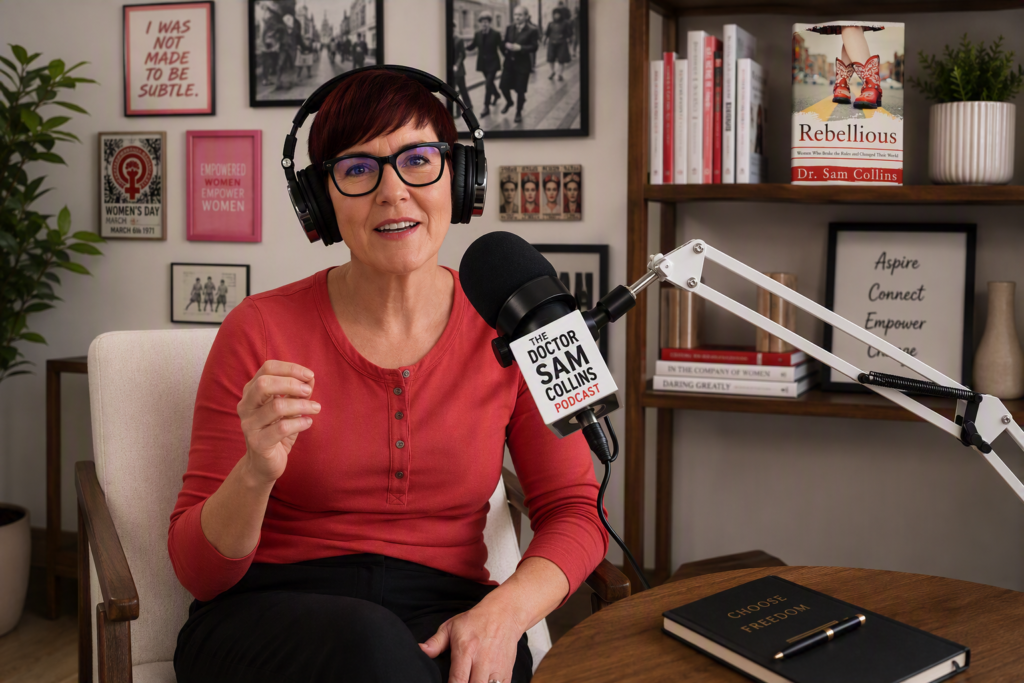
So the book is about to be launched. Finally! Yeah, I'm so excited. Finally. Finally, I know it's taken… Well, it's not taken so long. I thought it was a long time, but I think I started it while I was in 2020 in the depths of… COVID lockdown. Yes, absolutely. So it's not so bad. So rebellious, and you are one of my women who broke the rules and changed their world with your chapter, Choose Life.
So I want to start by asking you in the context of rebelliousness, and I know we've been redefining it a little bit in the book, what does it mean to you or what has it meant to you in your life being rebellious? Interesting question. I think for me, rebellious, I'm going to use another word. For me, it means more being resilient than rebellious. I think that has been my consistent word in how my life has evolved.
And I think, you know, when you hear the word rebellious, I think there's so many definitions for it. But I think for me, what stands out when you ask me that question is, is every time I felt like I was falling down, I still got up. And it was that resilience and that courage to get up that I felt a little bit, if I could use the word, rebellious in their choosing or the choices that I made in getting up, I guess.
So I think if I just answered that question, Sam, it would be my resilience. Yeah. And it's not so easy, is it? I think, you know, there's a lot of talk about rebelliousness and And there's a lot of talk about resilience, and I can see the interconnection between them. And it's not so easy to actually follow through and do it, is it, when you experience some of the things that you've experienced?
So tell us a little bit about your story and how you came to choose love and choose life. So how far back do you want me to go?
I was born and then I was no it's up to you wherever you want to start. Sam I and I it's interesting you know when I when you think through it I mean when I read the chapter as well I think all also the way we show up in life it depends on so many different variables and experiences and like I've shared before I grew up in an environment that was I grew up in Durban in South Africa during apartheid time.
I grew up in a home where my dad was an activist, and I grew up in a home where I was in an environment where my community was predominantly Indian and Black African, where I was quite, my lenses were quite aware of what was happening in our surroundings. And so, because of the home I grew up with, where we were constantly being told of what was happening in our world, in our South African world, I guess, I probably, I think as a child, internalized the way I chose to look through those lenses, I guess, in a very different way to how other kids may have chosen to look through those lenses.
And my home was a warm, loving home, but it also was a home that was filled with constant, I guess, survival would be the word it was. My dad was present but not present. My dad was fighting for the rights and justices of everyone else but was never present in the home. My mom was the glue that kept our family. We were part of a really good family network, a very close family where we were like the fun home for everyone to be in.
And my dad was kind of the role model for everyone. He came from a family of like 12 siblings where he was the only one that had an education. He was the only one that went to university and got qualifications. So he was the one that everyone came to for advice and and made decisions on family decisions. So I grew up in this environment where education and making decisions about your life was quite vital in a world where there was equality and justice.
And there was just always this constant struggle of what next. I grew up in an environment where education was important, rights were important, standing up for yourself was important. But it was interesting how that actually didn't happen on the other side, you know, in the family space because, you know, contrary to what was happening in the world, I guess. And I just made different choices watching that play out, I guess, in my family space.
So I saw this very strong father figure who was there for everyone else. but his family in that space. And I saw my mom being this really silent power, so to speak, of keeping everyone together, loving, nurturing. And I had this amazing brother as well. And then as I grew into the space, I just watched how I didn't feel like I fitted in to that conformed community of the Indian community of how women or or girls are in a home versus how boys are in a home traditionally, religiously, in a community space and stuff.
So I'm not going to say I felt different, I just had a different view of how I wanted to see the world. And then life just happened, you know, just in terms of watching things play out with my dad and my mom's relationship, or how my brother made his choices in the family space.
And if I had to think back, I think I went into my own survival space probably at the age of 13. And I remember when I started doing my own therapy work around myself, I realized that I felt like I lost a lot of my own childhood, so to speak, because I felt that I became an adult too soon trying to protect my mom and my brother in a way where No one asked me to, but I made those choices.
And I can't even answer those questions because no one asked me to do that. My mom didn't say mother me or my brother didn't say mother me. I just made those choices based on what I saw happening in my home or in my environment. And that started from such a young age. So becoming the rescuer was something I just became by choice. So I think the choosing started at quite a young age.
And then that rescuing became, you know, I shared with you a little bit about my brother making different choices and becoming the naughty one. And I'm being, you know, he was the delinquent and I was the good child. I was the one that, you know, did the things that a parent would want their child to do in terms of, you know, being the good girl and doing the right things, right in inverted commas, you know, studying and getting the education and being at home.
But I think I also made those choices because I wanted to protect my mum and I did that unconsciously as well. And so I grew up in that environment in Durban until I was I think about 27 when I left home and came to Johannesburg to start my own career. And at that time, it was such a hard decision for me as well to leave home because I think I also made a choice there for myself.
I chose to leave home because I felt I was not allowing myself to have experiences I wanted because I was just playing this rescue role and protective role and everyone else around me was having different experiences and here I was just making my choices based on everyone else. And I guess that played out till I went through all the different losses in my life as well. So, you know, the time when I left home, my brother had already been diagnosed with cancer at the time.
And I think that for me was also kind of an escapism in a way because I thought, oh, I was always living like, what next? And I constantly lived.
on a space of, okay, what was the next thing that was going to happen that I needed to be resilient about? What was the next thing I needed to wait, get, you know, I was going to be knocked down and then I needed to get up. So you were waiting for like the next disaster kind of thing to happen. And you were living in that space. And you, in a very short space of time, you unfortunately lost your entire family. yep yeah in my whole i guess in my whole 30s yeah in a space of nine years i guess yeah so my dad when i was just turning 31 and then my brother four years later and then my mom another four years later so it was like yeah so between 30 and 39 it was yeah my dad my brother and then my mom And such a critical time in your life as you're emerging, as you know, in your work and in your life.
And, you know, in the story we talk about when you unfortunately lost your mother and how you made certain decisions after that, how things changed quite radically for you as a result of all that loss. So tell us a bit more about that. You know, it's so interesting because the other day I was talking to someone and someone that's going through quite challenging times in their life. And I was saying to them that, you know, for the first time in my life, it's been so, like in the last few years, the last three and a half years, I guess, I've loved for the first time in my life, such an effortless, been in such an effortless space where everything has just been so effortless and happy.
And I said, it feels so surreal to be in that space because I've never known what it felt like. And so, you know, after my mum, I guess my journey started, Sam, around feeling like I belonged somewhere. I felt completely shattered because, you know, after my dad died, my brother had cancer. So it was like, you know, I went from one state to another, not grieving for my dad, you know, and you deal with, you know, you've also had everyone goes through losses in their life, different types of losses, and we all deal with them differently.
And I think I didn't have the time to deal with my dad's grief because it was moved on to Aldrin. And then after he died, I was like dealing with my dad and Aldrin. and then dealing with the impact it had on my mum and my sister-in-law at the time. And then suddenly my mum was gone. And I thought, oh my God, what does this mean now? I'm by myself. What does this actually mean for me?
And I completely felt a disconnect to the world. I felt that I didn't belong. I felt that I had literally been disconnected from everything. And I felt like I had to start again. I had to start this identity again of who am I? What choices do I want to make now? And what are the decisions I need to make for me? Because at this time, Sam, it was only me I had to think about, no one else.
Whereas before, there were so many other people that I needed to think about. It wasn't just Aletta. And for the first time, after 2013, it was just me that I had to think about. And that was the most difficult process for me ever, because I didn't know what Aletta liked, what I didn't like, what I wanted to do, what I didn't want to do, because I had no one to actually think through those things with.
It was just me. So I think I started a discovery process with myself around how did I want to live my life? What are the choices I want? I had so many choices to make at that time. And how do I just keep this light in me shining? How do I just honor myself? How do I just live again? And I think that's when I started my self-discovery of just trying to find out what Aletta wanted or liked or didn't like.
And it was a huge discovery for me because it was like a clean slate. And it was weird. It was such a weird feeling for me because I didn't know how. And then I had to start through my therapy. I remember once my therapist asking me what will happen because I had built these walls around me. And she said, I didn't know how to ask for help because I was always the one that helped others.
And she said, what would happen if your walls fell down? And I literally started, I felt like I was having a panic attack in that session. And I said, I don't know, she asked me, what's happening to you right now? And I said, you asked me that question and my, literally, I'm shutting down because I don't know how to answer that. And she says, what if you asked people that you felt safe with for help?
And I said, I don't know how to do that. And so, I had to start that whole journey of being vulnerable. And I found how powerful my vulnerability was at that time because there were so many people around me that loved me and cared for me and wanted to be part of my healing process. And I know I spoke about vulnerability as well, but I just realized how powerful that was for me to allow people.
So part of my making those choices. about myself was allowing people in. And through my journey, I found that I didn't need to belong specifically to someone. I needed to belong to me. And that was part of my own discovery that actually came to me when I was on my trip to Peru, when I was… And I think we wrote about that as well when I spoke about me being in that hotel room, where I realized, you know, I didn't need to belong to anyone.
I belong to me and I made choices for me and I can choose how I want to be. So I can be in a dark space or I can be in a light space and I can let that light shine or I can dim that light, however I choose to dim that light. So, And then I think just rollercoasted into so many different things that I made choices about then for me and what I want to do.
And I made mistakes. It wasn't perfect. I made some choices based on what self-love meant to me at that time, what I wanted to do, what I thought I wanted to do. South Africa just felt very painful for me because I just resonated in all these losses to me and I wanted to…
run away from South Africa. And I made some, you know, silly decisions around that. And it brought me right back here. And I made peace with those decisions as well. So yeah. Yeah, so, so many choices through that process. I remember writing the chapter, and there's that moment where your mum's in hospital, and she's not doing well. and you go to the gym just to get out for a bit and get some fresh air, I think.
And you come back from this workout and there are all these calls and you sort of rush back to hospital. But in that time in the gym, I remember very vividly that you're having this conversation in your mind with your mum and you're saying, choose life, please choose life. And ultimately for many reasons she couldn't and she passed on. And it feels like in some ways that you took that, you then took that mantle and said that you chose life and that your life went in this different direction based on that experience.
Do you feel like there's some truth to that? Probably did. I think for me it was asking her to choose life because I felt that she lived, I want, I felt that she had so much more to live through based on what she had gone through, losing her husband, losing her child. I think it's just not natural for any mother to lose her child. And I saw what it did to my mom after that.
So I think I wanted her to choose life for her, not for me, not for anyone else, but for her. And I think that resonated with me for anyone in terms of where I was at, that we must make choices for us based on where we're at in our life. And you're right. I even said that to her when I was in the hospital with her last few breaths, watching her leave.
I was begging her to choose life for herself. And clearly it wasn't what she had wanted or what was destined to be. And yes, that's the choice I made for myself because I was not going to make any other choices. I was choosing my life after that. And I still am. You know, I lost my mother when I was 21. And as dramatic and tragic as it is, and I know that moment where they slip away from you, I know now that I wouldn't be living this life. because I think like you, I was really close to my mom and I would have stayed probably in in Farnborough and Hampshire and England and got a job there and that would have been fine and that would have been that and that would have been my life and part of me sometimes grieves not having that life, you know, quote unquote, the normal life, doing what a lot of my friends from school have done perhaps, but I know I never would have had this adventurous life if she hadn't.
passed away. So there is, in some ways, there's gratitude there. That might sound like a strange thing to say. Do you feel gratitude in any way? Absolutely. And it feels like exactly like what you said, Sam. It feels weird to even say that because I would not have made any of those choices if my mum was around for myself. And it's interesting how you use gratitude because that's how I think through it, that I'm able, I'm grateful that I'm able to make those choices, you know, by my, you know, now that I am where I'm at right now.
And I would have never done that then. And I always wonder what would have happened, like, you know, my experience of going to the States and thinking that I was in love there and going into a disastrous relationship there that brought me right back here. I just think to myself, I would have never had that experience. And that experience taught me self love. That experience was a big choice that I made for myself because I would have never, ever, I mean, I packed up my whole life here.
I sold my house, my whole house that I had with my mom. I left my job. I am a comfort creature. Everyone knows how I love, you know, comfort and my home and my stuff. Packed everything to go and have this experience only to discover self-love. and come back and make a choice for myself. I would have never had that experience otherwise. That for me was a huge, huge choosing myself. A lot of women would go and stay in relationships like that because they made, you know, that choice and, you know, they say you make your bed and you lie in it.
I came back out of six months thinking, uh-uh, I don't care what anyone says, I'm choosing me and I'm coming back and I'll start from scratch and I did. came back with nothing, no job. I stayed with my sister-in-law and her little one. And I had no job, no car, no home. I was living out of the suitcase for a couple of months. And I thought to myself, oh my God, look what I've done.
And I made a choice for myself. And those were all the choices I made for myself through this, going through this process of discovering myself. But I've never had that opportunity.
What have you learned? You've mentioned self-love a couple of times, so what have you learned about self-love? I have learned that I am enough. I have learned that I do not need others' approval to love me, in terms of loving myself. I am enough just as I am with all my wounds and my trauma and my light and everything that I come with, I am enough and I don't have to prove myself to anyone.
I have learned that the choices that I make for myself matter, that it's not dependent on anyone else. I think self-love for me was also accepting just You know, I felt at one point, I felt that I was so tired of people feeling sorry for me, Sam. I always felt like when people looked at me, they really felt shame, like she's been through so much. And like I was just tired of people saying shame to me and saying, I'm so sorry you've been through so much.
And I felt that I didn't own my story enough. And When I started owning my story and owning my space and owning everything that I've come with from the time I was born, I felt that was my self-love. That was me just owning who I am with everything, all the colors, black, green, blue, everything. And I didn't know what self-love was before. I always wanted to be loved based on how other people loved me. because I felt like I just had so much, I was caring so much.
And that was self-love for me when I was able, you know, when I went into that emotionally abusive relationship and I thought like, what am I doing? I've just been through so much of trauma in my life. I'm here discovering who I am and this is not the choice that I want. I love myself enough, I am enough not to make this choice for myself. So I guess. Yeah, that was self love for me.
You see, this is the rebellious aspect for me. Because absolutely, you're resilient. We've got no debate on that, Aletta. But the rebellious element for me here is you choosing life, you choosing love, you choosing self love. That's the really key element for me here that's absolutely important. And that you you consistently made these choices in the face of changing circumstances, in the face of moving yourself completely to a different country, a different relationship, you doing different things.
This is what the rebellious piece is for me, because we may think that being rebellious is being difficult or aggressive or argumentative.
you know, terrible past, you know, all these kinds of stereotypes associated with rebelliousness, but this is not that, is it? No, not at all. It's very gentle. And you know, something that you reminded me of as well, when you were speaking, I was reading something the other day about joy. And whenever I think of joy, I always think of you. And it said that comparison is the thief of joy. And I was like, oh my God, that's so true.
Because when we compare ourselves against others or other people's perceptions of us, you're going to write that down, aren't you? I love it. And you know, I've talked about what I call comparisonitis, this sort of disease that's spreading through everyone when we compare ourselves against other people. We see on social media all the time, of course. and especially for young people, young girls causing so many problems. But the only person I think that you were comparing yourself against after all this was yourself.
You had this new barometer of I'm Aletta, this is what I want. And I think a lot of people would find that quite challenging and say, you know it's selfish and you know something that was going around in my head well she doesn't have kids you know well she does you know like we've got we make all these excuses up about why that wouldn't be possible for me but that's just all in our minds isn't it and absolutely it is all in our minds and and just think about it sam we're living in such a world where this comparison as comparisonitis as you say it is is It's such a real thing that's happening out there for everyone, like as women, as young women that are watching other people's lives, social media, you know, that are out there.
I was this young girl watching, like everyone other's life around me was just okay. I was the one that just had so much of stuff happening. know everybody else was like dating and getting married and you know doing fun stuff and I was just having death after death and trauma after trauma and it was just and then you just deflect because you're in a survival space and you know we all have different experiences that shape us I just went in this direction you know we all go in different directions and you know whether it's destiny whether it's a spiritual part of the choices that we've made.
I don't know, everyone has their own way of looking at it. Sometimes I look at what I have went through and I always wonder, how did I not have a nervous breakdown sometimes? How did I not give up? How did I not become dark and negative and ugly and addictive or go into some, you know, like how, how did I make those different choices for me? And that's why, you know, I speak about spirit and, you know, my spirituality or this light inside of me that shines so bright that I sometimes cannot even understand that because I just feel somewhere along the line, my path where it's written in the stars or wherever it's written has just been around. me having this kind of experience and me making these types of choices rather than because I couldn't identify I remember people saying to me if you don't do that or if you don't stop doing that you're going to have a nervous breakdown as well because you just are going going going and I was thinking like what are they talking about like should I wait for this nervous breakdown am I going to have this nervous breakdown.
Aletta, how do you smile again after being through so much? How do you still have so much of life in you? Because I do, and I can, and I am. I can still find things to laugh about. I have my days. Who doesn't have days where they feel sad or why did I have to? I mean, I'm busy planning a wedding now, Sam. I mean, I'm getting married at 49. I think like- Congratulations.
Thank you. And I think- That's going to be hard for me because I'm going to miss my mom and my dad and my brother. It's going to be a hard day for me. But on the same hand, I'm going to have different feelings, you know, like I'm going to feel sad. I'm going to feel happy. I'm going to feel joyful. And it's about that presencing, right, of the different emotions that we can feel through an experience.
I have my days where I feel really sad. and I miss my mum. And I'm sure you know what that feeling is where you just long for your mother's touch or just something from her. And you just have to just feel that emotion but presence yourself and then find something to smile about and connect to yourself again and find that light and choose and move forward. So for you, it's a conscious choosing. when you are in those moments.
And let's just say, and I think it's really important to say that light can live alongside dark and happy can live alongside sad. quite easily. We don't have to be happy all the time or sad all the time. We can have many emotions at once. And I think that's important because it's like, okay, now I'm depressed. Now I'm happy. I'm happy. I hope I don't get depressed again. I think that leads to some challenges for us.
But it seems for you that you consciously choose joy. And naturally, Sam, I just feel that It's such an empowering part of you when you're able to presence yourself like that with the different emotions. I feel empowered that I'm able to sit on my bed and my tears will be flowing down my face because I miss my mom and suddenly I'll be smiling at something because I see a beautiful flower outside or the sunlight is just reflecting in a way that really looks beautiful.
So that is such an empowering way to feel. And when you say choosing joy, it's in a natural way. It's not in a way that I force myself, okay, you know, when we prep ourselves and say, okay, you have to be happy now. You have to choose joy now. You know how we have the self-talk now, come now, you have to stop doing this and move on and, you know, life is like this and I don't do any of the self-talk.
It's just a natural flow of my choices, I guess. Yeah, that whole pick five things to be grateful for. You're like, okay, number one, number two. Yeah. I mean, I think this is a lot more flowing and a lot more natural, but you do have your radar out for them. And I think that's the important thing that I can, I can really hear that when you're in a dark place that you do make sure that you see the sunlight come through, that you do make sure that you focus on yourself and you've made these very conscious choices.
When you have these feelings, it's led. you two, you went to Peru and you went up Machu Picchu, that you went to America and you left your job and you started working for yourself and you started speaking and writing and all of these things that you've been doing. over these past years and that you will do so much, so much more. You are the absolute embodiment of light and joy. And at the same time, darkness and sadness at the same time, I just love that you have them all together and you're not just sort of running through the fields clapping about, oh, I'm so happy all the time.
Everybody, come on, it's easy. Because it's not effing easy at all. In fact, some days, You just want to stay under the covers and you're crying for your mom. And then the next minute you can be doing jumping jacks because you're alive. And I think that this is life and we should be absolutely grateful for it and delighted that you've made it to 49. And I'm 51 next week and we're still going.
Happy birthday for next week. You look great for 51.
I mean, anyway, I'm looking forward to being older. No, and I think it's the inside that shows a woman like us. It's our spirit that shows. I promise you, Sam, it's the light that shines from within. It's not even about an age, a number for me. I think we put so much pressure on people these days to be a certain way. to show up in a certain way. And that isn't pressure on itself.
It's that we dictate how people should be, and we have all these textbooks and these checklists. I'm sure you've read all these grief checklists of when you go through grief, you must go through these cycles, step one, step two. It doesn't happen like that. You can start at step 10 first and then go to step one 20 years later. You know, there's nothing that dictates, I mean, there's, I think there's a rhythm for everyone's experience of how we evolve.
I love that. There's a rhythm for everyone's experience as we evolve. I love that because there are so many linear diagrams out there, which are so masculine and so traditional and so outdated, like, okay, now I'm in the anger phase and then, and then like, oh, okay, I feel good. Oh, okay. I've gone back to anger. What the, you know. Exactly. Did I go backwards? And so I really enjoy what you're saying.
And I think it's going to give a lot of people a lot of peace of mind, a lot of peace of mind and a lot of… The feeling I always get when we speak, Aletta, is you're very soothing. Your impact is incredibly soothing. And I think we all need a lot of soothing right now, you know, there's so much, God, there's so much going on in the world. And so much, and at the same time, so much greatness, so much joy, so many people making new decisions that don't You know, I think we are maybe examples, as many others are, of people who had an extreme adversity and then have now healed or are in the process of healing and want to give back and do good things and help people.
It's kind of what our, you know. what we're about but there's lots of people i think that are making these choices now without having going having to have gone through the adversity which is wonderful like who wants to to have to go through all of that so you know i guess we all make our spiritual choices don't we but i i'd love to see many more people now making these kind of choices being way more conscious about who they are, what they do, where they go, what type of work they want to do, how many days they want to work, want to work from home, don't work from home.
I feel like sort of, it wasn't like that in my day, being like that person. And it wasn't, you know, we couldn't necessarily always make those choices. So the world is changing so radically. It's exciting. And making choices for them, not being, I just feel like we've lived.
like copycats like we copy we want to copy each other based on and I wish people more would understand that we all have our own experiences like choose your you know you know own your experience and make the choices based on yourself. Don't like, you know, we grew up in a world or a society that made us like copycats. So you've been through a divorce. Let me tell you what I went through.
And then you do the same thing and you'll be okay. Or you've been through, you've lost your mom. It's not the same thing. Sam, what you went through losing your mom, what I went through is too different processes, you've processed it differently. We may have similar, you know, we may connect with each other understanding what that loss could be like, but we've had different experiences. And if we could just exhale into understanding that we're all different, we have different experiences and make choices based on who you are.
That's self-love on its own. That's choosing you on its own. And I just wish, like, as we, you know, in these movements that, you know, you try, I mean, the work that you're doing, Sam, making such an impact with women and empowering them in so many different ways, you know, that's, I just wish that women with their lenses shift into owning that space for themselves, you know, making the choices for themselves.
And just, you know, I'm no different than anybody else next to me that's had an experience. I just made the choices for myself based on, you know, my experiences. So I just wish as we evolve and as this world unfolds and, you know, more of us out there that can share our light with like-minded women, that we're able to, because I mean, that's what I want. I want to have an impact on, you know, having making someone else think through and think, okay, so I can make choices for myself too.
You know, based on my own experiences, I don't have to listen to everyone else. So, yeah. Aletta, thank you very, very much for being part of the Stripped Back podcast today. And thank you for being in the book and rebellious.
Aletta has been through so much losing her entire nuclear family in less than a decade and one could absolutely forgive her for being in a much worse place than she currently is. And we could absolutely have that conversation about how difficult it has been for her and the adversity and how it has impacted her and how she has been resilient, which is how she started off the interview today. And what's so fascinating here is that she used this experience to be able to create new paths in her brain, new paths in her body, which ultimately led to new paths in her life, new job, new relationships, for example.
But I think what always strikes me as ultimately the most perfect thing about Aletta is how peaceful she is and how she talks about this light shining through her. And it absolutely does. It doesn't feel false or faked or manufactured in any way that she is able to live alongside her grief with joy. And that is, wow, that is a wonderful thing that she has managed to do. it feels without the self-help books or, or anything like that, that she has been able to make these conscious choices herself and she's a wonderful human being.
And I'm incredibly grateful that she's a part of my new book. rebellious coming up very soon. And, and that she, although she said that she wouldn't use the word rebellious, she absolutely is, of course, because she has this sort of soft loving rebelliousness where she said, no, I'm I refuse, you know, I refuse to, to have a breakdown in this way. I refuse to that instead. I want to live my life, live my absolute best life.
And that's, that's absolutely what she's doing.
Related content
 Podcast
44 min
Podcast
44 min
Love As A Force For Change
What if love is not a soft emotion, but a courageous business practice? In a world marked by conflict, division, political polarisation and organisational politics, Dr…
Podcast
55 min
For The Days You Want To Quit
When the demands of work, family, caring, relationships and the wider world feel overwhelming, Dr Sam Collins explores exhaustion, hope, purpose and why your contribution matters…
Podcast
37 min
The Great Pretence: Change It, Leave It or Create Something New
The Great Pretence: the collective performance through which organisations, institutions and professions maintain the appearance of progress while relying on systems that are no longer fit…
