Feminism For Women Who Don’t Call Themselves Feminists
Why women may already be one of the most powerful forces shaping the future—and how to recognise and use that influence intentionally through work, leadership and everyday decisions.
Most conversations about feminism focus on women’s rights, women’s advancement or women’s wellbeing.
All of those conversations matter.
But what if we’ve been thinking too small?
Women already influence trillions of dollars of capital, major technology platforms, supply chains, healthcare systems, education systems and employment practices. Why are we not treating women as one of the largest future shaping forces on the planet?
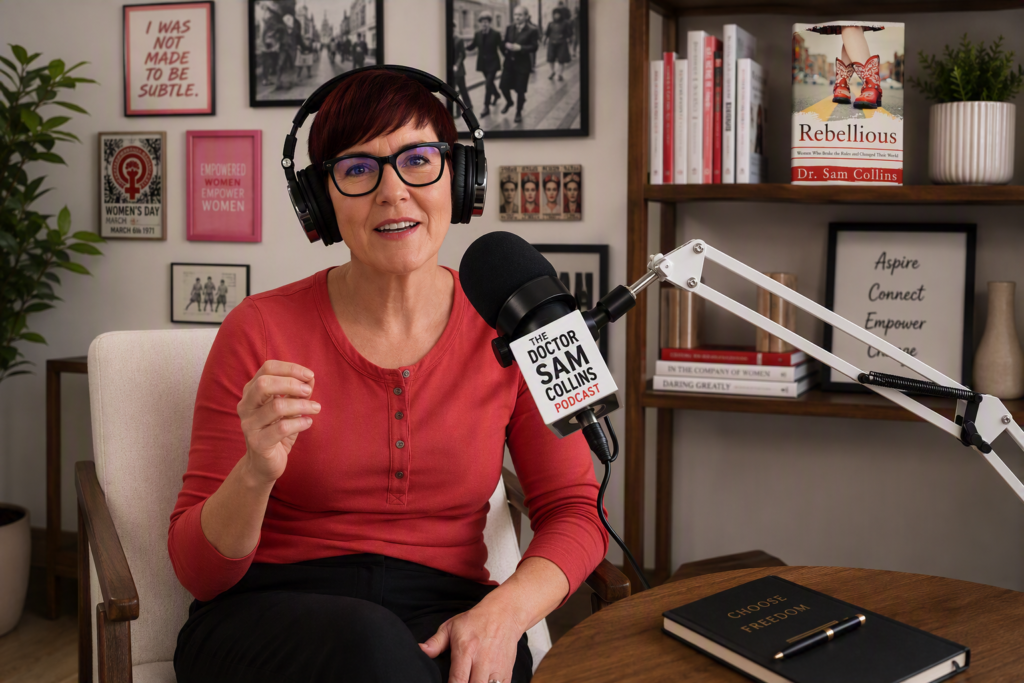
In this episode of The Dr Sam Collins Podcast, Sam explores a different question. Not just how women succeed in the world as it is, but what kind of world women want to help create.
Many women feel uncomfortable with the label feminist. Yet those same women are leading teams, raising families, shaping organisations, influencing communities, directing investment, building businesses, developing technology and making decisions that affect thousands of people every day.
Drawing on feminist history, personal reflection, more than 25 years of working with women leaders and a bold vision for the future, Sam explores why women may already be one of the most powerful forces shaping the world and why it is time for more of us to recognise that power and use it intentionally to make a difference in our world.
In this episode you’ll discover:
- Why so many women support feminist values but hesitate to call themselves feminists.
- Why rights, equality and wellbeing are still essential, but may not be the whole conversation.
- How women already influence business, technology, healthcare, education, communities and public life.
- Why business may be one of the most important areas of social change in the world today.
- The difference between having a seat at the table and helping shape the future.
- How to think more intentionally about the impact you are having through your work, leadership and everyday decisions.
- Inspiration for becoming a more conscious force for positive change.
A question to consider:
If women already influence so much of the world around us, what becomes possible when more of us recognise that influence and use it even more deliberately?
Listen & watch
Transcript
Transcript
Select a chapter to read along. Use “Play this clip” to jump to that moment.
Hello everyone and welcome to the Dr. Sam Collins podcast. Thank you so much for being here today. And for those of you that have been listening along and know that I’ve been promised you a shorter episodes, more punchy, more for you to be more podcast style. I take it all back today. This one’s going to be a little bit longer, but stay with me. I really hope that you’re going to find it at least insightful and maybe useful, even life changing or perhaps one of those phenomenal light bulb moments where you go, okay, wow, this is it. This is what it’s all about. So today I want to talk about feminism for the future. Stay with me. Don’t switch off when you hear the big F word. All right. I really want to talk about feminism because I believe that we need to reclaim it. All right. So I’m not talking about feminism as a historical lesson or anything like that. I do have some notes today. So if you see me looking down. That’s because I’ve got some notes because I want to make sure that I actually do say what I want to say. All right. So anyway, here we go. I don’t want to talk about feminism as a historical lesson. All right. Although I would like to talk a little bit about history because I think it’s very important. And if you’re going to talk about the future, then I believe we have to begin with what has already occurred. And this isn’t about feminism. really as a political argument or a label that everybody has to agree on, okay? I want to talk about feminism as a living, evolving force for change that you can become more involved with and it’s going to change your life and it’s going to change the lives of everyone you love. And it’s going to make a massive difference in your community, in your organization. Even if you work in a business, in a corporation, you think, what, how does feminism have a role to play? We’re going to talk about that today. And it’s going to help you to be the leader that you were born to be. All right. And so let’s talk about that because the future, it’s not something that we should just wait for out there waiting to happen to us. It’s being created every day through the decisions that you make in your work, in your businesses, with the technology that you use, who you vote for, what you do in your community, how you raise your family, how you care, how you lead. And please don’t think that you’re not a leader listening to this. You do not need to be a leader to be the most successful and influential person. In fact, most people that are, many people, let’s say, who are leading in the traditional sense are not actually leading, they’re more managing. Leading is about taking people somewhere, whether that’s an idea, a cause, a project, a program, influencing, having courage, and caring about those around you. Boundaries. They’re getting things done, which is also important, but they have to come together, alright? So whether you do lead a global corporation, you run your own small business, you work in public service, you… care for people, you campaign for change, or you’re simply wondering what it is that you want to do next in this next chapter of your life. And by the way, if you are listening to this thinking you’re far too old or far too young to do anything influential, then you’re in absolutely the right place because it is both the very young and the very old that I believe will be changing the world. So this is a timely and deeply personal conversation.
When I started Aspire, my organization in 2001, I was 29 and I at that time… decided to specialise in working with women. Women were never a market that I identified, an entrepreneurial niche that I thought would be commercially successful. In fact, many people told me that I would never be commercially successful because of specialising in working with women and what about all the men, etc. But for me, women were and are the point. I wanted to make a difference to women who made a difference, if that makes sense. So I’m looking to, I was always looking to have a sort of multiplier effect in my work, working with women who were already out there making a difference, and we all make a difference in our individual ways, and helping you to make that bigger difference so that we can have this ripple effect of change. Women like you with ideas, courage, vulnerabilities. talents and potential. Women like you who want your life to mean something. Women, now this is really important, women like you who care about not only your own success, and it’s okay to care about your own success, but you care about the impact that you have on people and the worlds around you. All right, now that is it. All right, that is really important. And over the last 25 years, I have worked with thousands and thousands of women from senior executives and entrepreneurs and charity leaders and activists and community workers and professionals and mums and carers and not mums. just so many amazing women and the conversations, whether they were a coaching conversation or in one of my workshops or events, was often about the same things. It was often about how to communicate to more dominant people, often men that they worked with in more traditional organisations. It’s been about confidence, it’s been about leadership, it’s been about influence, it’s been about… personal brand. It’s been about raising your profile and your presence and impact. And although these are and still remain to be important topics, and there are many coaches and women’s organizations and companies now that are helping women in this area. When I started, there weren’t, but now there are. But I do believe that we should not be talking any more purely about
how women can be more successful in the world as it is, but more importantly, what kind of world can women help to create? That is a question which I am obsessed with right now. And before we go even further, there’s something I want to say about feminism itself. Without feminism, we would not have which is still not there in many places, the education, the careers, the financial independence, the legal protections, the political voice and the freedoms that many of us do enjoy today. And we stand on the shoulders of extraordinary women who fought battles that many of us don’t have to fight, all right? So this is not a moment in any way, shape or form to abandon feminism. But perhaps it is a moment to reclaim feminism and perhaps it’s also a moment to keep evolving it and I believe many of the amazing women that we are in their footsteps some of which you may see behind me on my wall of the women’s movement and wall of feminism because feminism While feminism must continue to fight for women’s rights and safety and dignity and equality and freedom, where those things still remain under threat, I believe it can also become something more. So the first chapters of feminism quite rightly asked, what do women need in order to be free? The question I want to ask today is, what becomes possible when women use that freedom? to help shape the future? What if feminism is not only about what women are entitled to receive, but what they are able to contribute? What if the next chapter is not simply about women gaining access to power, but women using our voice, our knowledge, our experience, our wisdom, our creativity and influence to help build a better world? Not because women are better than men and not because women have all the answers, but because The future of this planet will be stronger, wiser, fairer and more humane when more women are fully involved in creating it. And who doesn’t want that? For me, feminism for the future is an invitation to see women not only as beneficiaries of change, but as agents of change. What do you think?
And not only because we’re seeking a better future for ourselves in the next promotion or career development or success at work, but as people we want to help create a better future for everyone. And I believe we are living through, and I would imagine that you might agree with me if you’ve got this far into my podcast, we are living through one of the most important periods of change. in modern history. Decisions that are being made right now about AI, climate, healthcare, work, democracy, business and human connections will shape not only our lives now, but the lives of future generations. And I do not believe that women should be confined to a side conversation about representation while those other decisions are being made. And you know what I’m talking about. When’s the last board meeting you were in, the last executive strategic document that you saw, the last report on commercial success that included women? that included maybe as a sideline, the women’s network, the employment, the employee group for women or the corporate social responsibility for women. It’s still on the sidelines, I believe, and not enough integrated into the future. We are helping to create the future. We are at least 50 percent and often more of the entire planet. And it’s still the case that while At entry level in many organizations, women will represent 50% of those people going into an organization. It’s still at the most senior levels that women are not represented. So because wherever you’re listening from today, whether you’re on the train going into work, you’re catching me for a few minutes before you’ve got a meeting that normally stresses you out. Maybe you’re a teacher in a classroom. Maybe you’re trying to figure out your next role or job move. Maybe you are in the community, a laboratory, a family, or you aspire to create a movement that changes the world. I have a feeling that your contribution is going to make the most massive difference.
believe that you’re too small or too young or too old to make a difference. Sometimes when we are at our lowest moments and we are feeling the most frustrated or upset or angry or even grieving we can really change our focus into how we can help and make a difference to others and that can give you the most fulfillment. you would have ever had. My own mother’s life and death left me with questions about what does it mean to be a woman in business? What does it mean to be a bright, capable, aspiring woman who cannot always cope? I remember seeing that with my own mother and being so impressed by her and her 1980s red power suits, but also seeing the pain on her face when she would come home from a long day at work and my traditional father still expecting his dinner on the table and feeling increasingly insecure when she started to earn more money than him. So we need to find a place where women’s outward success coupled with often tiredness, stress, pain, pressure but also possibility has a safe place to go. I wanted to create something with Aspire and I do believe I have that has helped women to live more fully and lead more freely and use their gifts in ways that really matter. And my purpose has been and will continue to be to my last puff of breath to make a difference to making a difference women. and help you to make a bigger difference in the worlds you touch. And for you to understand your own passions, your own potential to do that, and how being part of something bigger than yourself, a community, a tribe, a movement, whatever you want to call it, and perhaps we will call it feminism today, will be that we’ll make such a difference. Now, as I said, For years I have been involved with working with women to improve things like voice and communication and career planning and the rest of it, and I do believe that continues to be important. But I have longed for women to be able to understand that it is not you that needs to change. Yes, we can also always improve our skills. Yes, we can always look at how we think, our limiting beliefs and changing our habits and getting better systems around us to delegate and manage our time and all of those things. But they are not always as successful as they can be or will not work when we are in systems around us, organisational systems, cultural systems, societal systems,
family systems and even religious systems that can hold us back. So when we understand that, I want us to be able to think about how can we as women be agents of change, not only for ourselves, but for the systems around us. All right? Now, for you women out there who work in business, let me talk to you for a moment. For those of you that work in complex global organisations, that work in small or bigger businesses that are of course ultimately commercially led and are about the bottom line and profits and KPIs and all the rest of it. For those of you that are managers, senior leaders, directors, partners, executives, assistants, clerks, board members inside. global corporations, your decisions travel far. They travel beyond borders. They travel across different offices and impact many people. And I want to say to you directly, you are not standing outside of social change in your work every day. You do not need to You can, but you do not need to volunteer for a charity, go out into your community. start working for a not-for-profit to make a difference. You make a difference every day. The decisions that you are making about people, investments, technology, products, customers, supply chain, procurement, tax, public policy, and the environment are shaping the future. Your day job might be one of the most significant places where you can make a difference. Reflect for a moment. Think of one world you touch regularly. It may be a family, it may be a classroom, it may be a team, an organisation, a profession, a community, a customer base, a supply chain or even a country. What future is already being created right now and where do you influence it? even if you think you don’t, and whether or not anyone calls you a leader, all right? Just reflect on that for a moment. Now, I must, I’ve got itchy nose here, I must begin also by acknowledging that feminism, of course, has always been concerned about the future, all right? So women who fought to vote were not simply wanting a legal adjustment in their own time. Of course, they were changing the civic future for generations to come. Women who demanded education were changing who could produce knowledge and whose intelligence would shape society. Women who challenged property law, marital power, employment discrimination, sexual violence and reproductive control were contesting who counted as fully human, whose judgment carried authority and how power should be organized. Do you know about feminist waves? the language of the waves of feminism can really help to orient this. But it often tells us of a Western, especially American and British story of how these periods overlapped and made feminism look like a bit of a sequence of historical milestones. But really, this metaphor is a very helpful starting map. The first wave of feminism is commonly associated with our legal, property, citizenships, the vote. And the second wave come into more of a work and family, sexuality, reproductive, autonomy and culture. And the third wave really helped us to think through identity, difference, culture and exclusion. While the more recent fourth wave of feminism has used digital connection, the Me Too movement, for example, to expose harassment, abuse, violence, and allowing local experiences to become transnational conversations at extraordinary speed. But even…
That account is incomplete. As I learn more and try to understand more and decipher the academic scholars in this area, I start to understand. My own ignorance is, and to understand how black feminism has long shown that race, class and gender should not be separated without distorting women’s lives. Kimberle Crenshaw gave us the term intersectionality to a legal and analytical problem that black women have been articulating, quite frankly, for generations. Liberal feminism pursued legal equality. Radical feminism examined patriarchy and sexual politics and violence. Liberal feminism pursued legal equality and institutional access. Western feminism’s claim to universal truths. Eco-feminism and feminism climate justice work examines extraction care and the living world and feminist disability scholars challenge narrow ideas of independence, productivity and what bodies are treated as normal. This is what many people have been examining, researching and talking about for generations. There’s no single feminist theory which everyone agrees. Feminism is actually a field of argument as much as it is a movement for change. It contains disagreements about capitalism, the state, sexuality, identity, motherhood, care, religion, sex and gender, violence, work power and strategy. It can become overwhelming. And for us to ask, what is its applicability to me in my daily life? that feminism for the future should create a space that is easy to understand for all of us, that brings women’s histories, analysis, and aspirations to the shared work for all of us to imagine and build a more just future. So the history of women belongs in business too, because women fought to enter paid work. and professions to control their income, to build enterprises, to have their own businesses, to lead organizations and to participate in economic decision-making. Corporate careers have never been merely private achievements, have they? Access to work and leadership in the business world has altered independence, families, laws, markets and expectations. Access to work and leadership becomes too narrow when it’s celebrated only by individual women who reach the top. The continuing feminist question, I believe, is whether that access is actually changing the distribution and use of power and whether women inside business are and can help more to reshape institutions that profoundly shape modern life. I have heard many women say of now they are in the boardroom, but their voices aren’t necessarily being heard within that realm. So earlier movements made extraordinary gains and we must respect the inheritance. that holds this achievement and the critique together. We do not honor feminist history by pretending it was perfect. We honor it by learning from its courage and refuse to waste it on what is possible. So there is much unfinished work that we must not minimize.
We must, I believe, resist the seductive idea that feminism can somehow graduate from justice to aspiration. Justice is not the old work and imagination is the new work. We need both. A woman cannot coach her way out of a law that denies her rights. Confidence cannot substitute for physical safety. A vision board cannot create childcare, healthcare, clean water and political representation or a living wage. Telling women to choose freedom when freedom is constrained by violence or coercion or poverty or the state becomes cruel if it individualises what is structural. At the same time, structural analysis should not erase agency. Living Women who are living within severe constraints are not symbols of oppression waiting to be rescued by women with more privilege. They organize, negotiate, survive, create, resist, teach, care, lead and imagine as well. A young woman or any woman in India does not need a movement headquartered in the West to explain her future to her. She may need platforms, resources, safety, solidarity and access, but she also brings extraordinary wisdom to the rest of us and that which we need. The ethical task is not to speak to women whose realities differ from us. It is to build conditions in which more women can connect. be heard, influence decisions, and define the futures that matter to us and the rest of the planet. Global cannot mean exporting a polished Western model and asking and adding photographs from other countries. It cannot mean using women facing acute oppression as emotional evidence for a campaign. designed elsewhere. It must involve reciprocal learning, local leadership, language access, material inclusion, and acceptance that prioritizes women in Manchester, Nairobi, Mumbai, Tehran, San Paolo, Los Angeles, and wherever else. Solidarity does not mean sameness. It requires seriousness about one other’s freedom. and an unwillingness to accept that some women’s lives naturally matter less. Now, business is deeply implicated in this unfinished work. Companies can widen opportunity, they can create secure livelihoods and influence standards, but operations and business relationships can also produce or intensify harm. Pay systems, employment practices, workplace cultures, procurement choices, product designs and global supply chains all have gendered consequences. Have you ever thought about that? The International Labour Organization describes enterprises as critical actors in advancing gender equality through responsible business conduct. So feminism for the future is not about importing politics into a neutral business world and I think this is why perhaps many Women do not want to identify as a feminist or bring feminist principles into their business or corporation. A fear that it will be career limiting, a fear that it is somehow political and something that is not going to help to make solid business decisions. Quite the opposite, I believe. Now, I’m not suggesting here that individual businesswomen should somehow compensate for weak laws, institutional failure or global inequality.
individual agency matters. But so do boards, investors, incentives, regulations, trade unions, governments, public services and collective action. We need an honest account of where a woman has discretion, where she has allies and where the scale of change exceeds any one person’s authority. The proposition is not that feminism should stop defending rights. It is that defence cannot be the whole horizon. If women spend every generation re-arguing their right to live safely and participate fully, the future will continue to be designed elsewhere. We must produce and protect rights while also shaping the technology, economics, education, healthcare, work, democracy, climate policy and culture. We need resistance. and construction at the same time. Every generation needs change. Populations are ageing in many countries, while care systems remain strained and deeply gendered. Digital platforms need attention. Cultural and political debate, democracies face mistrust, polarisation and organised disinformation. Economic systems are generating remarkable innovation but are leaving people insecure, exhausted and excluded. Business continues to believe that it is on its own and separate from social change in many respects. These are feminist concerns because every transition
distributes power, risk, time, money, safety and opportunity. And corporations travel huge amounts of all of those things. Who designs the algorithm matters. Whose history appears in the data matters. Who owns the technology matters. Who performs work matters. Whose language, body and face is recognized. matters. Who receives the benefits and who can change a decision matters. A technological future is also a social and political future, and supposedly neutral systems and meritocracies can scale inherited inequalities with extraordinary inefficiency. For women inside global companies, These questions are immediate for you. A technology manager, director, executive may influence an AI system and whether it is tested across language, skin tones and social constructs, and whether people can actually challenge an automated outcome. A finance leader, you can shape which risks are considered. You can. and what human or environmental costs will remain outside of your calculations or will be included within them. A procurement director may influence conditions across a complex supplier network. A product leader may decide whose body, household, income or disability is imagined as the default customer. A people leader may shape You may shape pay, progression, flexibility, parental leave, safety and the everyday experience at work. These are not softer concerns besides strategy. They are part of what strategy will do to change the world. Climate change cannot be separated from gender. Environmental effects are mediated by existing inequality and feminist justice asks who are exposed, who decides and whose labour adaption counts, who receives finance and whose knowledge counts. Current UN Women explicitly connects feminist climate and environmental justice with rights representation finance, care, resilience and just transitions. Feminists for the Future should not acknowledge that feminists are already developing the analysis. Our contribution is not to claim the territory but to connect to it in a broad accessible movement and to the decisions that you make in the world every day and in the worlds that you touch. Imagine if every day as you were about to do your to-do list, you got up and said to yourself, if I was to look at my to-do list and the meetings that I’m doing and how I speak through a gender or feminist lens or in a lens of how I can change the world, I wonder how your decisions might just a little bit or maybe quite a lot change how you do things. This is not about a list of policies benefiting women. I want you to start seeing the world in a different way. It enables us to see things that perhaps we didn’t see before, to hear what we didn’t hear before, to become more frustrated when before we would have quietly accepted. It connects both the personal intimate of what goes on inside our heads and the institutional frustration systems change that is happening. every day around us, the kitchen and the economy, the body and the state, the personal stories and the distribution of our resources, our resources both internally and our resources both externally, how we shape our social position and those that we influence around us. I hope that you are hearing this and feeling hopeful as to what is possible for women, that if we can collectively think in this way, feel in this way, and support each other in this way, it leads to a level of new consciousness raising, of storytelling and collective interpretation. We discover that what might feel sometimes like failure
may actually be a shared pattern with structural causes, not our own individual failure. Stories are not substitutes for tangible facts and evidence, but they are an experience which can never be contradicted because it is our own personal story. They can reveal questions that data never can. They connect us. to our hearts and to action. Our strongest model, I believe, combines scholarship, evidence, our stories and experience, but most importantly, our practical experimentation. So for much of this modern feminist struggle, our urgent question was access. Could women vote, study, achieve, own property, own professions? stand for office, control our reproductive decisions, leave abusive relationships and participate in organisational and public life. These struggles remain unfinished and in some places are newly threatened, are reversing, going backwards. And in some places access is expanding at the same time. And another question emerges from me. What are women now having access to? And what do we do once we are there? This is not a dismissal of a seat at the table. I’m a strong believer in having a seat at the table. Decision-making is real and representation can change what is seen and decided. But the metaphor has become too comfortable. It assumes that the table is legitimate, the menu is desirable, and the room is worth entering. Many women I speak to, while incredibly capable of reaching the senior leadership table of their corporation, their business, even their charity, not-for-profit or country, and politics are reluctant to do so for fear that they may be moving from the frying pan into the fire, so to speak. Will it just be the same? Is there any opportunity I can really make a difference there? Will it be that I will still continue to be more exhausted and have no life? Many women are looking at the senior level room and wondering, is it really worth it? not only for my own personal experience but can I really make a difference there? Is it the influential place I was promised? Many instead are asking perhaps there is a different room that I may enter. So authorship here is very important. We need reform but is it that we need reform or redesign or do we need a complete re-creation? in some respects. A woman can reach the top and still find herself trying to communicate in a way that those traditional around her will understand, she may still feel small, insignificant. She may still feel frustrated and holding back for a desire to be seen as professional, as intelligent, as having the right answers. She may find herself still having to maintain the cultures and definitions of success that she does not actually believe in, and she may find herself incredibly alone. Authorship here is stronger than access because it includes a sense of imagination, purpose, and responsibility. It asks not only whether women are present, but whether women have adapted so much that they are exactly the same as those that they did not ever intend to be in order to get to where they wanted to be. Whether women are really influencing the questions, the values and the measures that design and government the future that we aspire to have. Who defines progress?
Who defines balance? Who defines authenticity? Who defines professionalism? Who defines leadership? Who decides what technology should optimise? What risks are acceptable? What counts as economic value? Who imagines the future of education, care, cities, peace and work? Access who enters the story. Who is allowed to bring their intuition into a board meeting without necessarily the facts, research, data to back herself up? Who is brave enough to do such a thing? For women in corporations, authorship means refusing to separate commercial competence from social consequence. A budget is an ethical document as well as a financial one because it shows what an organisation will resource. A strategy is a theory of the future because it commits capital, people and attention to one set of possibilities rather than another. Culture is not created by values on a wall but by how leaders behave, what they reward. tolerate, promote and protect. A woman does not need to abandon commercial realism to exercise feminist leadership. You need to expand realism so that people, communities, long-term resistance and resilience and the planet are included in what the business regards as real. It does not mean formal authority. A young teacher in the middle of England may not write national policy, but you shape the future because what you notice, teach, refuse to talk about and you do talk about and you protect makes a massive difference every day. A young woman who works in America in a corporation might not control the international development budget, but you bring knowledge about your community, your technology, an opportunity that outsiders can’t manufacture. Everyone, we make a difference. You don’t need to be working in business. A carer will shape the dignity of others at the most vulnerable moments of their life. These are not identical forms of power. They are different forms of power. And local influence must not be romanticised as compensation for structural exclusion. But these are all forms of future making. That’s what I am trying to say here. Our individual success can inspire us. but it does not automatically transform conditions for other women. The woman who has reached the most senior level of her organisation by not holding up the ladder for women behind her, by being very politically astute to her male counterparts and changing how she is in order to adapt, does not. automatically transform conditions for other women, and we may argue, may hold women back. One woman’s promotion is not a movement. Collective power begins when women connect personal experience to shared patterns, widen possibility, transfer resources and our knowledge.
challenge systems, create alternatives and remain accountable to women whose realities differ from our own. The question becomes not only how far can I go, but what is possible because I was here. So in this central proposition here today, It’s that women everywhere, we are looking to participate more fully in imagining, designing and building just, equitable, peaceful and sustainable futures. We honour feminism’s work for rights, safety, body autonomy, economic justice, representation and freedom. This is a real inheritance that we bring with us. And perhaps particularly acute in this day after the passing of Gloria Steinem last week, the holding of the torch that now is transferred to many of us around the world. What will you do with your torch? How brightly will it burn? How many others will see it and feel the energy of it? and want to come along with you. Isn’t that truly what leadership actually is? Your ability to influence others and bring others along with you. A more just, equitable and sustainable world. Justice. Justice means the ability to confront violence, exclusion, and unequal power. Equity means recognising that identical treatment does not correct unequal conditions. Sustainability means ecological responsibility and forms of work and contribution that do not depend on exhausting women, workers, carers, communities or even the earth that we stand on. Peace includes dignity, safety, democratic participation, and freedom from domination. Freedom means both freedom from coercion, but freedom to think, fredom to be, freedom to feel, freedom to create, to belong, and to contribute. My framework today is hopeful without, I hope, becoming too naive for you. It’s not a claim that progress is inevitable and everything is going to be okay tomorrow. Anger belongs here because injustice makes us angry. Even grief belongs here because it makes us who we are. It makes us understand how we are all here in some way to channel these emotions into something that gives us dignity, safety and freedom. Your participation matters. I am not asking you to build a global movement, write five books, speak to thousands of people and become something that you’re not. Although for some of you, I’m sure those things I listed, at least one or two of them might sound quite appealing. I’m asking you to stand on the shoulders
Of the extraordinary women that came before us. What would they say to us now? What would they ask for us to do/ When they look at our world and all that we have achieved, I think that they would be incredibly impressed, wouldn’t they? Wow, they would say, you can do that job. You can wear those clothes. You have access to this kind of information. I think they would ask us, what will you do with it? How will you make a difference? What will your contribution look like? I believe that they would say to us, yes, we were scared too. Yes, we came under much ridicule. What helped us? It helped us to be together. It helped us to connect. It helped us when we realised that we weren’t alone. It helped us when we organised. It helped us when we had systems. It helped us when we had goals. It helped us when we had the most amazing male allies around us, our husbands, our brothers, those men that got it. You know who I’m talking about, and some of you, I hope, are listening. This isn’t about women versus men. This is about, and has always been about, I think they would say, a better world for everyone. Women may move now from focusing on the fight to understanding the freedom. We will still fight. We will fight for what is right in a world that may seem that it is going backwards. And I think perhaps the women before us will say, we felt like that too. They will give us hope and say that there is much amazing possibilities to come. So I invite you today, whoever you are, whatever age you are, wherever you come from, whether you come from a council estate like me or you were born into a lot more privilege, should we say, whatever country you come from or live in, whatever social background you have, whether you work in the traditional sense of working in a business or a charity or a not-for-profit or a government body, whoever you are.
I want you to take this talk away and think to yourself, how can I be just a little bit more feminist? How would I stand? What would I say? Perhaps there might be a meeting, a conversation that you will conduct differently today. Maybe it will purely be your energy and your persona and your presence that will be different. Maybe you will feel connected to many sisters around you. Thank you for listening to Feminism for the Future. We are all part of it. Commercial discipline and social justice cannot be separate. They must co-exist. I urge you to connect to your purpose just a little bit more, all right? In your buying decisions, in your… decisions online, in how you talk to your children, in how you talk to your parents, in how you work with your teams. Thank you for listening to Dr. Sam Collins podcast, and I will see you next time.
Related content
 Podcast
48 min
Podcast
48 min
The Secret Women Activists Among Us
Dr Sam Collins explores how women are quietly using influence, information, relationships, courage and collective action to challenge unfairness and create change inside the systems where…
Podcast
44 min
Love As A Force For Change
What if love is not a soft emotion, but a courageous business practice? In a world marked by conflict, division, political polarisation and organisational politics, Dr…
Podcast
55 min
For The Days You Want To Quit
When the demands of work, family, caring, relationships and the wider world feel overwhelming, Dr Sam Collins explores exhaustion, hope, purpose and why your contribution matters…
