The “Difficult” Woman
What if "Difficult" Women Are Exactly What the Future Needs?
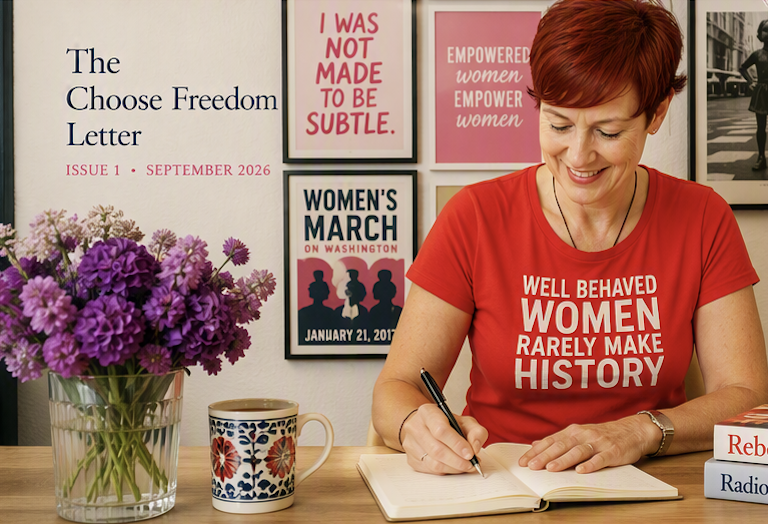
A Letter From Me to You.
Dear Reader,
For years, I have sent you emails about events, books, research and all the things happening across Aspire. This letter is different.
I believe we are living through a moment that demands more from all of us. The future is not something that happens to us. It is something we create through the choices we make, the conversations we start, the courage we show and the causes we choose to stand for.
Over the past 25 years, I have worked with extraordinary women leading businesses, teams, charities, research projects and social movements. What strikes me is not a lack of talent or ambition. It is how many are now asking deeper questions about freedom, influence, purpose and the future they want to help create for not only their careers, but for society.
That is why this letter is more personal. Because the story of how we change the world is inseparable from the story of how we change ourselves. Our doubts, hopes, setbacks, acts of courage and moments of freedom matter. They shape who we become and what we are willing to stand for.
Each month, I’ll share my thoughts about how we become braver and louder about the future we are creating, both for ourselves and for the generations that follow.
What if “Difficult” Women Are Exactly What the Future Needs?
The feminist activist Carol Hanisch popularised the phrase “the personal is political” in her 1969 essay. More than half a century later, those words still matter because our personal experiences shape how we lead, how we work, how we raise families, how we build organisations and how we respond when something needs to change. Whether the world we want to influence is a family, a company, a community or the world itself, a personal experience can make us notice what has been normalised, question who holds authority and decide that something must, and should, be different.
So, for this first letter, I want to tell you a personal story about my knee. It may not sound like the most obvious place to begin a letter about women, leadership and society, but perhaps that is the point. The experiences that change us do not always arrive with a grand announcement. Sometimes they begin in an ordinary conversation, when somebody expects us to accept what we are being told and we decide to ask another question.
I have had a problem with my knee for years. In 2020, while walking my dog, I tripped on the street. It was the middle of COVID and I never really got it properly investigated. Since then, there have been more falls, more pain and more frustration. Eventually, after quite a lot of advocating for myself, I got the MRI I had been asking for.
The doctor who called to discuss the results assured me that, at 55, I was “very young”. Unfortunately, that was the only thing he said that I found remotely reassuring. From the moment the call began, I could not get a word in edgeways. There was plenty of information, but very little sense that there was a human being on the other end of the phone trying to understand what all this might mean for the rest of mobility.
At one point, he compared my knee to a car with three wheels working and one wheel not working, which he described as “old and tired”. I could not resist asking, “Would you drive a car where one wheel wasn’t working, and wouldn’t that be illegal?” It seemed a perfectly reasonable response to his analogy. He ignored me and moved on.
Towards the end of the call, he asked what I assume he is required to ask: “Have I answered all your questions to your satisfaction?” I replied, “Not really.” There was a pause. He sounded genuinely surprised, as though the script had gone wrong. I tried to explain that I was hearing everything I could not do, but I still did not understand what I could do. He responded by launching into much the same technical explanation he had already given me, perhaps assuming that the problem was that I had not listened properly the first time.
It had become clear that we were not having the same conversation. I was trying to understand my future. He was explaining why I should accept his conclusion. Eventually, in a tone that I heard as entirely sarcastic, he said, “Well, if what I’m saying isn’t good enough, I can introduce you to two more surgeons and you can get their opinions as well. Then you will have spoken to everyone in our department. Would that be good enough for you?” I am fairly sure he expected me to say that it would not be necessary. Instead, I accepted his offer. Yes, I told him. That would be very helpful. I would appreciate the opportunity to speak with them.
What I am most pleased about is that I did not become annoyed. I did not argue with him, try to match his sarcasm or waste my energy proving that I had a right to ask more questions. I accepted the offer. Perhaps I now have a “difficult woman” note on my medical file: the woman who asks too many questions, challenges car analogies, refuses to be reassured by technical explanations and has the audacity to say that her questions have not been answered.
The truth is that I am comfortable being the difficult woman. Too often, “difficult” is the word applied to a woman who will not make herself convenient. It is used for the woman who asks for evidence, names what is not working, challenges the person with the title, refuses a dismissive answer or keeps speaking when the room would prefer her to become agreeable.
I am also discovering that being difficult can be enjoyable. I do not mean being sarcastic, cynical, unkind or confrontational. I mean the quiet satisfaction of raising the question, planting the seed or opening the conversation, then letting go of the need to control what happens next. There is something liberating about recognising that you do not have to win every argument or persuade every person. Sometimes your responsibility is simply to say what needs to be said.
Being difficult is not the same as being unreasonable. Sometimes it is the beginning of successful leadership. It is how unsafe practices are questioned, stale cultures are changed, poor decisions are exposed and possibilities that other people have dismissed are brought into the room. Being called difficult is sometimes the price a woman pays for exercising leadership before the people around her are ready to recognise it as leadership.
The bigger story, therefore, is not an irritating surgeon, a damaged knee or the fact that my body is ageing. The bigger story is who gets to define the limits of the future. An expert may understand a particular field, but that does not make that person the expert on the whole of your career or life or the world around you. A diagnosis, a manager’s opinion, a rejection, a setback or an established way of doing things can give you important information. It should not automatically be given the power to write the rest of your story.
If you find yourself questioning what comes next, whether the path you’ve followed is still the right one or how you want to use your influence in the years ahead, I would encourage you to look carefully at the assumptions you may have accepted about what is possible. Sometimes the biggest limitation is not a lack of capability. It is an inherited idea of what we’re allowed to want.
If you are wondering whether you can do it, whether you belong or whether you are good enough, I want you to look around properly. Look hard at some of the people who are already running things and ask whether your competence, compassion and willingness to learn might be exactly what leadership needs and what the world needs. Confidence is not proof of capability and doubt is not proof that you are incapable. Sometimes doubt means you understand the responsibility and you care about getting it right.
My knee may never be what it once was and I still have more questions than answers about what happens next. But I can still build, create, write, learn, contribute and help shape the future. Perhaps some things will require a different route. Perhaps I will need more help, more patience or a more compassionate expert. None of that requires me to accept a smaller identity or surrender my right to question what I am being told.
So, my invitation to you this month is to notice where you have stopped asking the difficult question, accepted a limiting answer or waited for a level of certainty that far less capable people never seem to require of themselves. Then choose one place to become more difficult, not for the sake of conflict, but in service of something that matters.
Perhaps that means applying for the role, questioning the decision, asking for another opinion, saying what everyone else is avoiding, taking some time off, putting forward the idea or campaigning for something you believe in. Perhaps it simply means refusing to allow somebody else’s confidence, title or certainty to become your limitation.
I cannot guarantee that being difficult will secure your next promotion or help you climb the career ladder. It may not make you popular and it may not make the people around you comfortable. We are not yet living in a world where women are rewarded for being bold, brave, questioning and unwilling to make themselves smaller. Too often, women are still expected to be agreeable, grateful and easy to manage.
But I can guarantee that a life spent continually shrinking yourself will not feel like freedom. A life spent silencing your instincts will not feel like freedom. A life spent waiting for permission to become who you already know you could be will not feel like freedom.
There is something deeply satisfying about knowing that you spoke when it mattered, asked the question, challenged the assumption, took the risk and showed up fully. Not because success was guaranteed, but because you decided to become the kind of woman who would no longer abandon herself to keep everyone else comfortable.
The world does not need more women who have perfected the art of being agreeable. It needs women who care enough to challenge what is no longer good enough, who are brave enough to become louder and who are willing to help create what comes next. Others may sometimes call you difficult. I am beginning to think of it as the leadership skill of the future.
I cannot promise that it will always be easy. But I can promise you this: it is one of the ways you will create a life well lived.
I’d Love To Hear From You.
This is a letter, and letters are meant to be answered.
Where are you willing to be more difficult?
Please reply to this letter, I read every one.
Sam
Related content
 Newsletter
The “Power-For” Woman
We talk a lot about empowering women. But women also need actual power. Power to influence, challenge, open doors, move resources and create change.
