
You Don't Need More Confidence
Many of us spend years waiting to feel confident enough before we speak up, pursue a dream, apply for a promotion, launch a business or make a change in our lives or the world around…
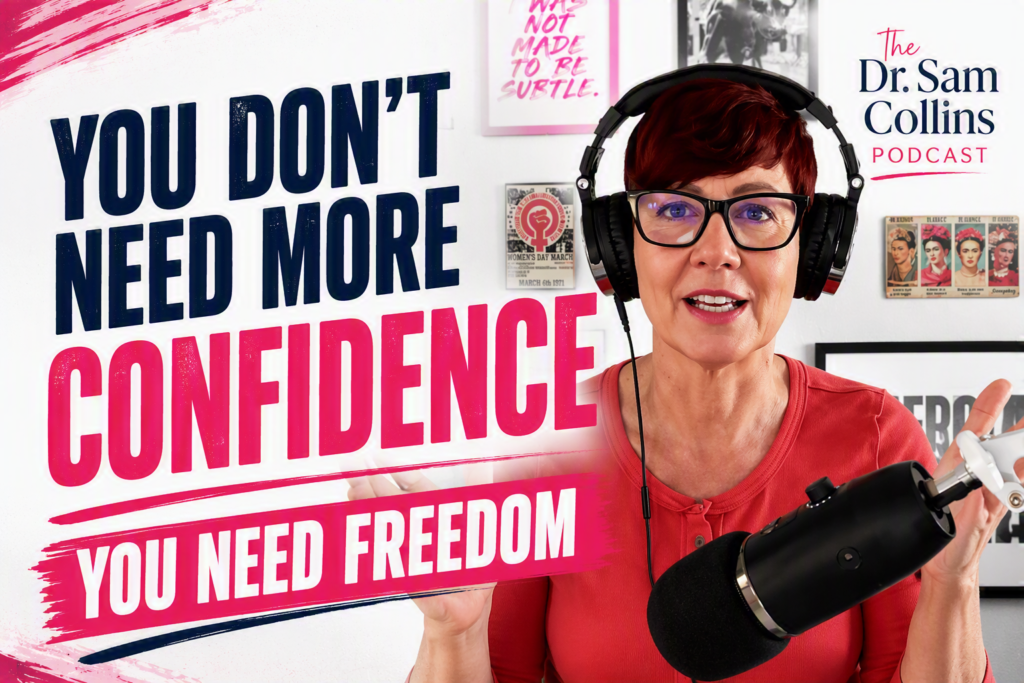
Many of us spend years waiting to feel confident enough before we speak up, pursue a dream, apply for a promotion, launch a business or make a change in our lives or the world around us.
But what if confidence isn’t the answer?
In this episode, I challenge one of the most common messages women receive and share why I believe confidence is largely a myth. Instead, I explore the power of courage, why it can be developed like a muscle and how focusing on something bigger than ourselves can help us take action even when fear is present.
Drawing on my own experience coaching senior women leaders and working with organisations around the world, I share a personal story about finding the courage to challenge powerful systems, influence difficult conversations and create change in environments where I didn’t always feel confident.
If you’ve been waiting until you feel ready, this episode may encourage you to stop waiting and start building your courage muscle instead.
In this episode:
• Why confidence can become a trap • The difference between fear and courage • How courage develops like a muscle • Why “stepping outside your comfort zone” isn’t always the answer • How focusing on the people and causes you care about can make you much braver • Small daily actions that strengthen courage over time
Listen & watch
Transcript
Transcript
Select a chapter to read along. Use “Play this clip” to jump to that moment.
Hello everyone and welcome to the Dr. Sam Collins podcast. I'm going to talk today about something that I don't really want to talk about and that is confidence, women and confidence. Why don't I want to talk about this? Because you certainly do not need to listen to another podcast about confidence. There's so much out there about confidence. So… What I want to say is this, confidence is a complete myth. I know there's this whole thing like you can become more confident, fake it till you make it, you don't want to be overconfident.
And I do believe that we get stuck in such a big loop of confidence. And so many of us believing that we can't do certain things, speak up, public speak, do a podcast, write something. apply for a job until we have this miraculous confidence that suddenly it covers us and we're all so perfect and ready for everything. I don't believe it's actually even a thing. So I don't want to talk about confidence.
I do though, want to talk about courage and where it comes from, how to get more of it.
and how to have it as a sustainable force in your life. Now, as much as I loved the book Feel the Fear and Do It Anyway, I don't love feeling fear. Fear is very debilitating for me. It makes me worry, it makes me anxious. It makes me do lots of spreadsheets where I do things like pros and cons, and then I'm analysing it. And rather than it making me feel any better, most of the time it makes me feel worse and stops me doing things.
And I get the whole thing that fear is there to protect you and keep you safe and the rest of it, but a focus on fear I have not found to be terrifically helpful. Also when people tell me things like, okay, What motivates you if you do apply for the job, you're going to feel more confident and you're going to be able to achieve your potential and all of this stuff. It still doesn't work for me personally.
I just feel even worse and even more scared. And I am, I think at the most natural me, quite a sort of cautious, risk averse type person. So I have had to learn how to be more courageous and I want to share how I've done that and how it's made me so much freer and giving me the ability to have a much better life for myself and also to be able to contribute to others in the world and I think in a much better way.
So if you'd like a bit more courage, now's.
the time to stop whatever you're doing and listen in. All right. I remember one time, some years ago, I was, I had a consultancy piece of work on gender equality in a law firm, big global law firm. And I was terrified at this whole idea because I didn't really think I knew what I was doing. They're smart people. They wanted me to work with their female partners and coach them to be more satisfied in their jobs and to be better role models and mentors.
And after doing that for some time I realised it was actually nothing to do with the women and the women were all great, just grossly overworked and judged and having to really survive in quite a traditional male-oriented environment. It was actually many of the male partners, more importantly the culture and system of the industry in general and how this particular law firm ran itself. And so I decided that if I was going to make any kind of real significant difference, I needed to be in conversation with the senior partners of this law firm who at that time, not now, but at that time were all men and quite traditional men in their thinking.
And so this was all absorbing for me. And I remember anyway, I was on, I was out and I was walking with my husband. We were out for a walk. I remember the kids were really little and I was… God, I'm, I'm worried about this. I don't really know what to say to them. Whenever I say anything, they like, they fight me. They object, objection, they object, and they want the data.
They want the analysis. They want the research. And I just find myself going around and around in circles with these guys.
Anyway, I remember my husband, bless him Robert, he said to me, you know what, Sam? And he comes out with these really random, irritating, but very powerful one-liners a lot. We're walking along. And he said, Sam, your courage muscle. Oh, okay. He said, your courage muscle is very flabby. And I go, what do you mean my courage muscle is very flabby? He said, Yeah. He said, your courage muscle, you know, you need to imagine you go to the gym and it's like a physical muscle and you need to punch them in the face.
Not literally scrub that. Anyway. So I was moving courage muscle. He said, yes, courage is something that you can learn. You can get better at, you can become more courageous. Now I actually really liked this idea because it's not I didn't see it as this sort of, some people are really courageous. You look out into the world and people and you think, oh my God, they're so brave. They're so courageous. How do they do the things that they do?
That's not me. I just don't have that gene. I don't have that part of me that has that inbuilt courage. But what I've learned from Robert, from my work and from many extraordinary people I've had the privilege to work with is that
It's totally and utterly learnable and you can develop it and grow it like you would a physical muscle in the gym. I loved this idea because I don't really like the gym either. And whenever I've gone into the gym, I've never really been able to sustain the gym because I go in and I try and do too much too soon. So the idea as well with this courage muscle, if you want to go with me on this. is that we can build it up slowly.
You can do 10 reps and then the next day you could do 10 reps again. And the next day you can think, I don't want to go to the gym. I'm going to eat ice cream. I'm going to do no reps. Then the day after that, you can go back feeling guilty because you had ice cream the day before and actually do 20 reps and improve yourself over time. And I think this is really phenomenal.
So that's the first thing I want you to understand that courage is learnable and it can grow over time.
Second thing though, is how do you do it? People would say things like, step outside of your comfort zone and because that's where the magic happens. And in that place is when you become all this brave and courageous person. Again, I'm not a massive fan of stepping out of the comfort zone because it doesn't feel very good. It's uncomfortable naturally because the comfort zone's nice. But so doing things that are uncomfortable is not my favorite thing.
So pushing yourself to do something uncomfortable. So people do this all the time. Okay, I'm going to cycle across the UK, I'm going to walk across Africa or whatever it is that is completely wonderful, but insane. We push ourselves to do things just to make this kind of idea of make yourself do it. I know some people do have success with that, but it's never really worked for me. Or if it works, it's very short term.
I can definitely make myself go to the gym. Maybe I can make myself go to the gym if… I've stepped on the scales and I'm really overweight. I'm not fitting into my clothes or I've got a goal of a party or a holiday or whatever stupid things coming up, right? Yes, I can make myself do it, but then I'll get a little bit fitter and I'll stop going to the gym. I'm not interested anymore.
It's not sustainable. Are any of you resonating with me? Push yourself out of your comfort zone, all this stuff. It's just such crap. All right. So instead of push yourself out of your comfort zone.
I have found that pulling myself into something that I really want, something positive. Now I'm not talking about, I want to get into a size eight, not that I've done that for a very long time, probably since I was 12 years old, a size eight clothing, or I want to look amazing for the debut or whatever crap that's going on. No, I'm not talking about that. I'm talking about pulling myself. into something that is really important to me that also is something that I'm passionate about seeing as a change in the outside world.
And it's going to benefit other people. Now, I think this is really important. I am not talking about sacrificing yourself for some worthy cause. I'm not talking about that. What I am talking about is that we women And not all, not just women, but this is a very, I'm going to say genetically, biologically, whatever part of us, we will do more. We're wired this way. I don't know what it is. The mother instinct, whether we're technically mothers or not, the mothering in us, we are wired to do more for other people than we would do for ourselves.
That's something that causes lots of problems and causes us to not look after ourself and there's so much on self-care you can find. But also I am talking about leveraging that for good, meaning that if you have other people in mind, you are much more likely to be motivated and have more courage to do things that you wouldn't normally do. I have seen now.
or whether it's true or not or whatever, you can fight me on it. But there are incidences out there where a woman has lifted a car because there's a loved one trapped underneath the car. What's going on? Because if you said to that woman, could you please go lift the car? She probably, I wouldn't be able to lift a car, but I would do my utmost to lift that car. If someone I loved, or really if anyone, is underneath the car, you find some apparently testosterone and other chemicals and you find some kind of superhuman strength.
Because it's not just about ourselves or something abstract. It's because we are focused on those that we love and we care about. We're much more likely to do more. We're going to apply for that promotion if we need to provide for our family. We're going to speak up at our kids' school if our kid is getting bullied. We're going to speak up in the meeting if we're sick and tired of how the organisation treats us and treats people around us.
We're going to apply to be a politician, a local government, if we just can't stand that there's so many people homeless now in our community and we just can't be that person that keeps walking by and thinking it's someone else's problem. So when we are focused on what we care about, who we care about, we become more courageous. So when, going back to my story, when Robert was telling me, you need to improve your courage muscle, and I'm thinking my courage, he's telling me my courage muscle is flabby.
How do I improve my courage muscle? He said, the women that you're working with right now, those women that are tired and frustrated in this law firm, those that feel like there is no change ever going to happen, that the structure and system of how it runs will never be any different. Those that you're working with that believe that they would never become or would never want to become. the senior partner or a managing partner in that law firm.
And if they did, they would be able to really have an influence and an impact to change probably generations of women, young women and young men coming into that law firm. Those that believe that is impossible, can you have them in your mind's eye when you are talking to the male partners? And rather than seeing them as adversaries, is that the right words? Forgive me. I never quite say the right word, opponents.
Rather than seeing them as opponents, rather than seeing them as difficult and having them shut you down and rather than feeling that you have to fight, that this is an opportunity for you to be courageous in your points of view. And if it doesn't come out right, just like it just didn't, just then.
If you don't say it in quite the right way, if they don't believe you, if they think that you're too young, too female, too emotional, whatever it is, it's going to enable you, Sam, to develop stronger arguments, to develop more articulate arguments, to understand how to convince them, how to influence them, which are skills that would be amazing for you to develop. and help you to create the changes that you want to change.
So it was almost like I could feel this army of amazing female partners and associates behind me as I was having these conversations. And that, having them in my mind's eye, that enabled me to be more courageous. It enabled me to build my flabby, still a bit flabby, my flabby courage muscles into ones that became more toned, more able to handle and weather a storm. They enabled me to become bolder. And in doing that enabled me to have more of an influence and more of an impact and enabled me to be able to teach others to have that too.
All right. And so I wanted to share this with you that courage is completely and utterly
learnable over time. So it's something we can actually work at. It comes from inside. And the starting point and key to that, developing that courage is first to understand that it's learnable. It's not some genetic gift that some people get and some people don't. And that when we have a passion, a cause, others in our mind's eye very strongly that is important to us, we will stand up. more, we will have more courage because it's something that we believe in and we want to see that change.
Then we create a place where we can develop a platform where we are able to articulate our arguments more eloquently. We're able to influence and convince. We're able to deal much better with rejection and objection. and even get to a point where we might even welcome that kind of objection and rejection because it's giving us a chance to make an even bigger difference in the world and focus on our communication style and be authentic and make the difference that we were all born to make.
This isn't about becoming suddenly fearless and not having fear. I am scared.
of something pretty much every day. They can be small things. They can be large things. I'm a pretty anxious person, but I put that in one box, anxiety and fear. And I am rather than focusing on overcoming those, I think they will probably be with me in that box. And I want to keep them as much as I can in that box as much of my life. But there is another important muscle in my brain and body, and that's the courage muscle.
So I invite you to find yours and to start toning it up and getting ready and exercising and going to your own courage gym and taking baby steps. Remember, this isn't about going to the gym and doing too much too soon. That's how we pull those muscles and we don't want to go back again.
Slowly but surely, perhaps speak up when you wouldn't normally. Perhaps think something that you wouldn't normally. Perhaps you finish work a little earlier than you would normally. A very courageous and rebellious action for many. Perhaps you have more sleep. Perhaps you eat in a way that is very nourishing and nurturing for yourself. Perhaps you do not feel so guilty though when you do things that you eat too much or you don't do all the exercise or the things that you said that you were going to do, but you get yourself back on track, back on the train so that you can become consistent in your courage journey.
So thank you for listening to the Dr. Sam Collins podcast today on moving from confident to fearless. to courage and go be a bit more courageous today. Enjoy yourself doing it and look and see how you get to, in our own small and sometimes large individual ways, change and shape the world around us. Thank you. And I look forward to next time.
Related content
 Podcast
48 min
Podcast
48 min
The Secret Women Activists Among Us
Dr Sam Collins explores how women are quietly using influence, information, relationships, courage and collective action to challenge unfairness and create change inside the systems where…
 Podcast
55 min
Podcast
55 min
For The Days You Want To Quit
When the demands of work, family, caring, relationships and the wider world feel overwhelming, Dr Sam Collins explores exhaustion, hope, purpose and why your contribution matters…
Podcast
52 min
Feminism For Women Who Don’t Call Themselves Feminists
Why women may already be one of the most powerful forces shaping the future—and how to recognise and use that influence intentionally through work, leadership and…
